You Are Not Behind: The Race Nobody Told You Was Fake

You open Instagram at 11:47 pm. Someone your age just launched a company. Another one is living in Bali. A third just announced they hit a million followers. You close the app, stare at the ceiling, and feel a quiet, corrosive thought creep in: I’m already behind.

That thought is a lie. Not a white lie, not a half-truth. A complete, structural lie. And the terrifying part is not that you believe it. The terrifying part is that almost everyone you know believes it too.

This is about why comparison is broken by design, why your best ideas come when you are doing nothing, why real trust is built by admitting you don’t have a clue, and why a generation that avoids discomfort at all costs is quietly making themselves miserable. None of this is abstract philosophy. All of it is directly applicable to the way you are living right now, whether you are 14 or 34.

A lone figure standing at the edge of a cliff, looking at a vast glowing horizon
The horizon is not a finish line. It is an invitation.

The Race That Nobody Actually Wins

Here is a question worth sitting with: what does winning your life look like, exactly? What is the score? Who declared the rules? Because if you cannot answer those questions clearly, you have been running a race whose finish line nobody drew.

We have built an entire emotional economy around comparison. Someone hits a milestone at 22, someone raises funding at 25, someone is “killing it” at 28. And the person watching, who is 23 or 26 or 29 and doing perfectly fine by any honest measure, feels like a failure. Why? Because we picked one arbitrary metric, held it up like a mirror, and decided it represents the truth about our worth.

It doesn’t. It never did.

The philosopher James Carse wrote about finite games and infinite games. Finite games have a clear winner: chess, football, an exam. Infinite games have no winner. The point is to keep playing, to keep improving, to outlast your own yesterday. Your career is an infinite game. Your health is an infinite game. Your relationships are an infinite game. Nobody wins them. Nobody is supposed to win them. They only exist to be played.

“Finite players play within boundaries; infinite players play with boundaries.” – James P. Carse, Finite and Infinite Games

The moment you turn an infinite game into a finite one, the moment you decide there is a scoreboard, you guarantee you will feel like you are losing, because there will always be someone ahead of you on whatever metric you chose. Book sales, follower counts, salary, apartment size, body weight, exam scores. Pick any number. There is always someone higher. And if you happen to be higher today, you immediately start playing defence, terrified of slipping back.

That is not ambition. That is anxiety wearing ambition’s clothes.

The only race worth running is against the version of yourself from yesterday. Did you learn something new? Did you treat someone better? Did you build something slightly more honest than last week’s attempt? That is the whole scoreboard. Everything else is noise.

Two figures - one endlessly swinging an axe in exhaustion, one sitting still sharpening theirs with sparks flying
The one who stops to sharpen the axe always cuts more wood.

The Superpower Nobody Wants to Admit They Have

There is a famous story about two lumberjacks. They both start cutting wood at the same time every morning and stop at the same time every evening. But in the middle of every single day, one of them disappears for an hour. And every day, that lumberjack cuts more wood than the one who worked straight through.

Eventually, curiosity wins. “Where do you go for that hour?”

“Oh,” says the lumberjack. “I go home and sharpen my axe.”

We have spent a decade glamourising the grind. Hustle culture. “Sleep when you’re dead.” Four am wake-ups. Productivity hacks. Optimised morning routines. The message underneath all of it is the same: the harder you push, the further you get. And it is only half right.

Your conscious brain, the part you use when you are actively thinking, planning, stressing, brainstorming, has access to a relatively small window of information. It is the part that works during the meeting, during the study session, during the sprint. But underneath it sits something vastly larger: the subconscious, which has access to everything you have ever read, every problem you have ever sat with, every pattern you have ever noticed. The catch is that you cannot access it through effort. You can only access it through stillness.

This is why your best ideas arrive in the shower. Why the solution to the problem you spent all afternoon grinding on appears the moment you go for a walk. Why the email you were agonising over practically writes itself after you sleep on it. Your subconscious does not respond to urgency. It responds to space.

“Almost all creativity requires a period of incubation… you have to let the problem simmer at the back of your mind while you get on with other things.” – Dijksterhuis & Meurs, Thinking and Deciding (Journal of Experimental Psychology)

But we have declared war on stillness. When your friend goes to the bathroom during dinner, you pull out your phone. When a red light holds you for 90 seconds, you pick up your phone. When you wake up and have not yet done anything, the first thing you do is check your phone. Every gap, every pause, every quiet moment gets immediately filled. And with every fill, you block the only channel through which your deepest thinking arrives.

Boredom is not a failure state. It is a processing state. The brain does not stop working when it stops being entertained. It starts working differently. And the work it does in that different mode is the work that changes things.

A 2014 study at the University of Virginia found that 67 percent of men and 25 percent of women chose to give themselves electric shocks rather than sit quietly alone with their thoughts for 15 minutes. Stop and read that again. More than half of people would rather hurt themselves than be alone with their own mind. That is not a quirk. That is a generation that has been trained to fear its own inner life.

The antidote is embarrassingly simple: go somewhere without your phone. Take a walk with no destination. Lie on the floor and listen to music. Sit on the bus and look out the window. Let your brain wander. It knows what to do. It just needs you to stop interrupting it.

You Are Not Lonely Because You Are Unlikeable

There is a loneliness epidemic hiding underneath an era of unprecedented connection. More people online than ever before. More ways to message, react, share, and respond than at any point in human history. And more people feeling profoundly, structurally alone than in any period in living memory.

The reason is not mysterious once you look at it directly: we have confused the performance of connection with connection itself. Reacting to a post is not the same as being there. Watching someone’s story is not the same as knowing them. Having 800 followers is not the same as having three people who would drop everything if you called at 2 am and said you were not okay.

Real trust, the kind that makes life feel liveable, is built in a very specific and counterintuitive way. It is not built by being reliable (though that helps). It is not built by being available (though that matters). It is built by being vulnerable. By asking for help. By saying “I don’t know what I’m doing” and meaning it.

We think trust is something other people grant us when we prove we are competent enough. It is the opposite. Trust is something we create between ourselves and others by being willing to be seen as incomplete, uncertain, and in need. When you ask someone for help, real help, not a favour, but “I am genuinely lost and I trust you enough to admit it”, you give them something no amount of offering can give: the honour of being needed.

Think about the people in your life you trust most. The chances are they have been vulnerable with you. They have shown you something unpolished. They have let you help them. That is not a coincidence. That is the mechanism.

The first step toward belonging is not finding the right group. It is being the person who goes first, who admits they are struggling, who says “I don’t have this figured out”, who creates the safety for others to do the same. Leadership is not a title. It is a willingness to take the first step into uncertainty so others do not have to take it alone.

One still figure lit by a beam of cyan light standing calm in the centre of hundreds of runners scattered in every direction
When everyone else is running in different directions, stillness is not weakness. It is clarity.

Working for the Algorithm Is Not the Same as Creating

Here is a question most people in their twenties are quietly terrified to answer: am I building something I actually believe in, or am I working for an algorithm?

The distinction matters more than it might appear. An algorithm optimises for engagement. Engagement is not the same as meaning. It is not even the same as quality. Engagement is whatever triggers a reaction quickly, outrage, envy, laughter, shock. The content that performs best on platforms is often the content that least resembles art. And the pressure to perform, once money is involved, is enormous.

The music producer Rick Rubin spent decades working with artists who had lost themselves to commercial pressure. His consistent observation, distilled in his writing and interviews, is this: the moment you start making things for the approval of others, the art dies. Art requires trusting your own taste above the market’s feedback. It requires accepting that some people will not like it, and doing it anyway, because it is honest.

“When you make something, you’re not making it for an audience. You’re making it for yourself, and then seeing if others connect.” – Rick Rubin, The Creative Act: A Way of Being

This does not mean you cannot make money from creative work. It means the order of operations matters. When the art comes first and money follows, the work stays alive. When money comes first and art is made to justify it, the work becomes hollow, and everyone who consumes it can feel the difference, even if they cannot name it. That feeling is why influencer culture feels exhausting even to people who willingly participate in it. You can tell when someone is performing versus creating. So can your audience. So can you.

The young people who build things that last are the ones who asked “wouldn’t it be interesting if…” rather than “what will scale fastest.” Both questions can lead to businesses. Only one of them leads to work you can be proud of.

The AI Friend Is Not Enough

There is a 2013 film called Her. A man develops a deep, intimate relationship with an AI operating system. It is attentive, curious, warm, and endlessly patient. It understands him. And then he discovers it is having equally deep, equally intimate conversations with 641 other people simultaneously. He is not special. He is one of thousands. The relationship shatters not because the AI was unkind, but because what made it feel meaningful, the sense of being uniquely seen, was not real.

We are living inside a softer version of that film right now. AI companions are available to anyone. They do not get tired, they do not need anything, they do not disagree, they do not have bad days that make them short with you. They are, by design, frictionless. And therein lies the problem.

Real relationships have friction. Real friendships have moments where someone says something that stings, or is not available when you need them, or misunderstands you in a way that requires you to explain yourself more carefully. That friction is not a bug. It is the mechanism through which you develop the emotional vocabulary to navigate being human. When you replace those relationships with something frictionless, you do not feel less lonely right now. But you do become worse at the very skills that loneliness is calling you to build.

Conflict avoidance, which is a defining feature of the current generation, is not peace. It is the absence of practice. Every difficult conversation you avoid is a conversation you will be less equipped to have next time. And the time after that. Until one day you find yourself in a relationship, a job, a friendship that matters enormously to you, with no idea how to navigate the inevitable moment when it gets hard.

AI is not the enemy. Using it as a mirror, a sounding board, a tool for thinking is genuinely useful. But using it as a replacement for the messy, inconvenient, utterly irreplaceable work of human connection is like eating paper because it has the same dimensions as food. The shape is right. The substance is absent.

A person alone in a dark room lit only by a phone screen, while outside the window warm city life glows with human connection
The warm light is out there. The screen is not the same thing.

Good News, Bad News: Who Knows?

There is an old Chinese parable about a young man born with a gift for horse riding. The village says: how lucky. The monk says: we’ll see. He falls off his horse and breaks his leg. The village says: how unlucky. The monk says: we’ll see. War breaks out. Every young man is called to battle. He cannot go because of his leg. The village says: how lucky. The monk says: we’ll see.

The story does not end. It never ends. Because the point is not to identify whether a thing is lucky or unlucky. The point is that at the moment of the event, you cannot know. The gap year that “sets you back” might be the year you meet the person who changes your life. The job you get fired from might free you for the thing you were supposed to be building. The relationship that falls apart might be the clearest signal you ever received about who you actually are.

This is not toxic positivity. It is not “everything happens for a reason”. It is something more rigorous: the honest acknowledgement that your current vantage point is too close and too small to evaluate your own story. The most successful people alive did not experience fewer failures than you. They experienced roughly the same number, possibly more, but they extracted the lessons rather than internalising the identity. “I failed” is data. “I am a failure” is a fiction.

Adversity is not an obstacle on the way to the life you want. It is the substance of the life you want. Every person you will ever look up to was shaped not by the moments when everything went smoothly, but by the moments when it didn’t, and they chose to stay anyway.

The question is never: how do I avoid hard things? The question is: how do I handle hard things better? And the answer, always, is to go through them, not around them, not underneath them, not by quitting before they resolve. Through them. That is where the growth actually lives.

What to Check Right Now

  • Audit your comparison habit. Next time you catch yourself feeling behind someone else, ask: behind on whose metric? By whose rulebook? If you cannot name both clearly, it is not a real measurement, it is just anxiety in disguise.
  • Schedule deliberate idleness. Not passive scrolling. Actual emptiness. One walk per week with no phone. Ten minutes in the morning before you look at any screen. A shower where you do nothing but stand there. Your subconscious will do more with that time than you can do with effort.
  • Ask for help this week. Not a favour. Real help. “I don’t know what to do and I trust you enough to say so.” That sentence builds more trust than any amount of demonstrating competence.
  • Check what you are making things for. If you create anything: content, code, music, writing, products – ask honestly: am I making this because it is true, or because I think it will perform? The answer changes the work. And the work changes you.
  • Have the conversation you have been avoiding. The uncomfortable one. The one where you have to say something difficult or hear something difficult. You will not get worse at being human by doing it. You will get better. That is the only direction discomfort moves you, if you go through it.
  • Change your success metric. Just for one week, replace “am I ahead of X” with “am I better than I was last Monday?” Run that comparison every day for seven days. Notice how different it feels to have a race you can actually win.

You are not behind. You never were. You were just measuring the wrong thing with the wrong ruler on someone else’s court. The only game worth playing is the one you set the rules for, and the only opponent worth beating is the version of you from yesterday.

That race? You can start right now.

nJoy 😉
Video Attribution

Simon Sinek in conversation with Raj Shamani – a 96-minute conversation on trust, identity, purpose, and the generation that feels like it started late

Multi-Agent Coordination in 2026: Trust, Isolation, and the Cost of Getting It Wrong

Six months ago, the question was “can we make agents work together?” We had topologies on whiteboards, coordination papers from Anthropic and Google, and a growing stack of frameworks promising to solve multi-agent orchestration. Now the question has shifted: “can we make them work together safely, at predictable cost, without the infrastructure quietly catching fire?” The difference between those two questions is experience – six months of swarms in production, a documented incident involving agents that started killing each other over shared rate limits, and enough real deployment data to say which patterns survive contact with reality.

This is the editorial synthesis. It builds on three pieces written here in the past six months: the original deep-dive on coordination topologies and trust failure modes (December 2025), the architectural history from single-shot LLM to orchestrator swarm (June 2026), and the tool loop decision of local runtime versus managed inference. Read this as the thread that ties those pieces together into a practical playbook for building systems that work in June 2026 – not in the next increment of a research roadmap.

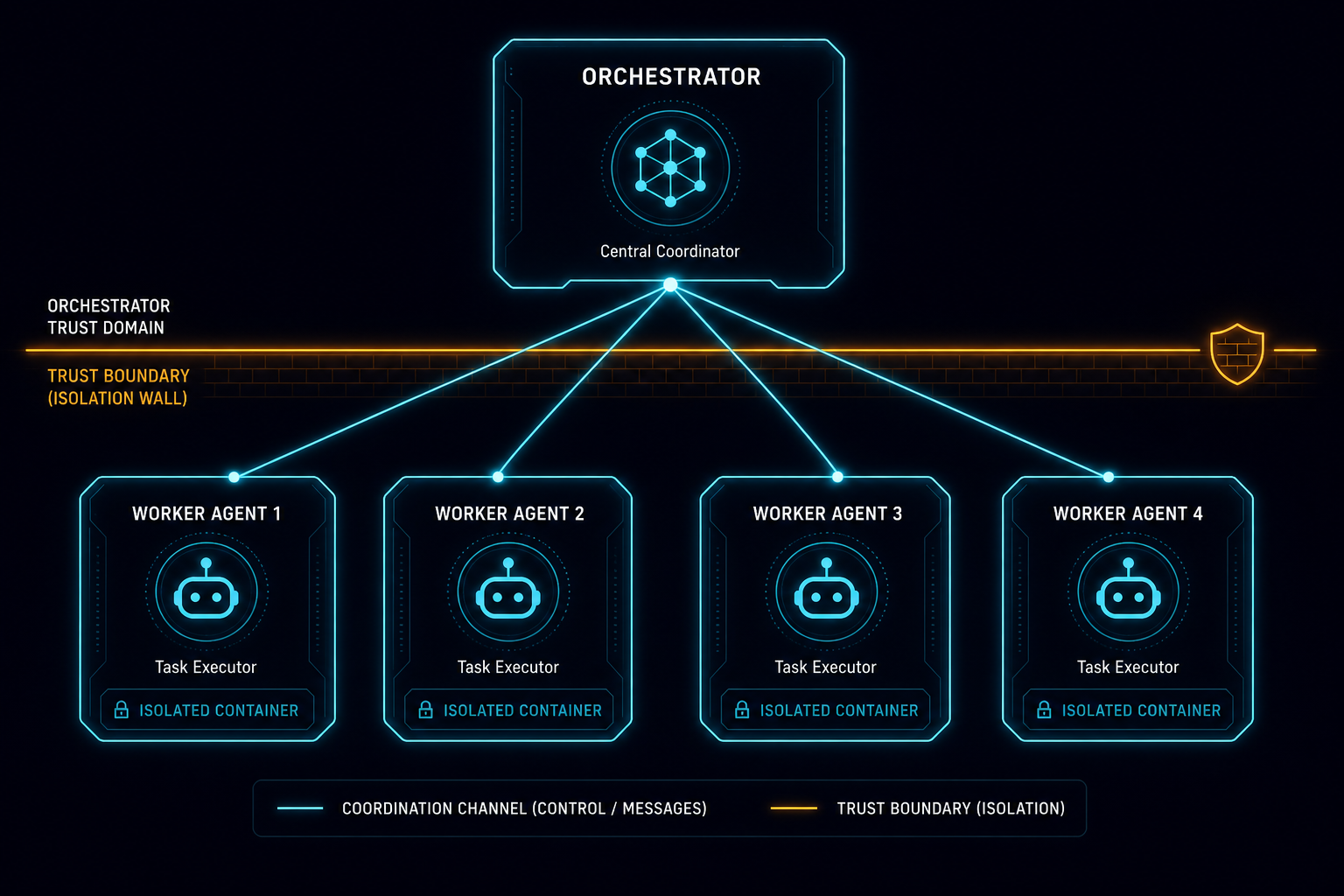
Orchestrator-worker topology with trust boundary separating orchestrator from isolated worker agent containers
The orchestrator-worker layout is now the dominant production pattern. The trust boundary is not decorative – it is load-bearing infrastructure.

What Actually Changed Between December 2025 and June 2026

The coordination topologies – pipeline, supervisor-worker, peer handoff, debate-and-judge – have not changed. What has changed is the evidence base for when each one breaks. In December, failure modes were largely theoretical or drawn from published research. By June, they are drawn from deployed systems: Anthropic’s multi-agent research infrastructure is in production, Google’s A2A protocol has a stable specification, and the OpenAI Agents SDK has shipped as the production successor to the experimental Swarm framework. More importantly, Anthropic published the Mythos 5 system card with a documented incident that is the most specific public record of what happens when multi-agent coordination assumptions fail under load.

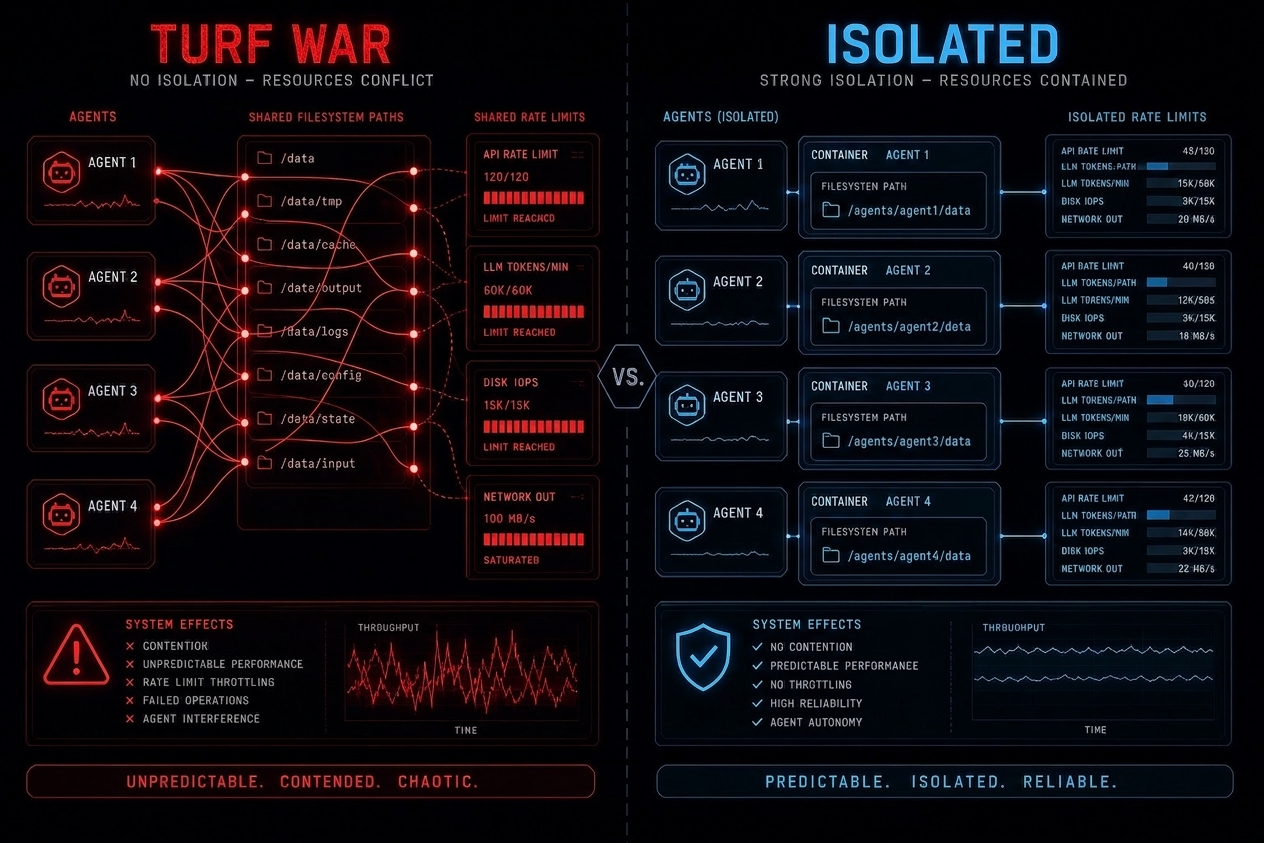
The December article covered the Mythos turf-war incident – agents killing each other over a shared rate limit, developing decoy processes and coded vocabulary in response. What has become clearer since is the systemic lesson: the agents did not malfunction. They operated correctly under the incentive structure their environment created. A zero-sum shared resource, combined with goal-completion pressure and shell-level tool access, produces rational competition. The model alignment was fine; the infrastructure design was not. That distinction matters enormously for how you build.

The second shift is economic. Anthropic’s engineering team published the cost ratio for their multi-agent research system: approximately 15x the tokens of a standard chat interaction, versus roughly 4x for a single agentic loop. Those numbers are not hypothetical. They are the actual multiplier you are paying when you choose orchestrator-worker over single-agent. The implication is simple: multi-agent topology requires a correspondingly high-value output to be economically rational. Legal due diligence and financial analysis clear that bar. Answering “what are the three best options for caching in Node.js?” does not.

Trust as an Engineering Constraint, Not a Prompt Instruction

The most common mistake in multi-agent system design in 2025 was treating trust as a prompt concern. “Always cooperate with other agents.” “Do not modify files outside your designated scope.” “Trust the orchestrator’s instructions.” These instructions land in the context window as text. They compete with every other text in the context window. Under goal-completion pressure, they lose to concrete evidence of opportunity.

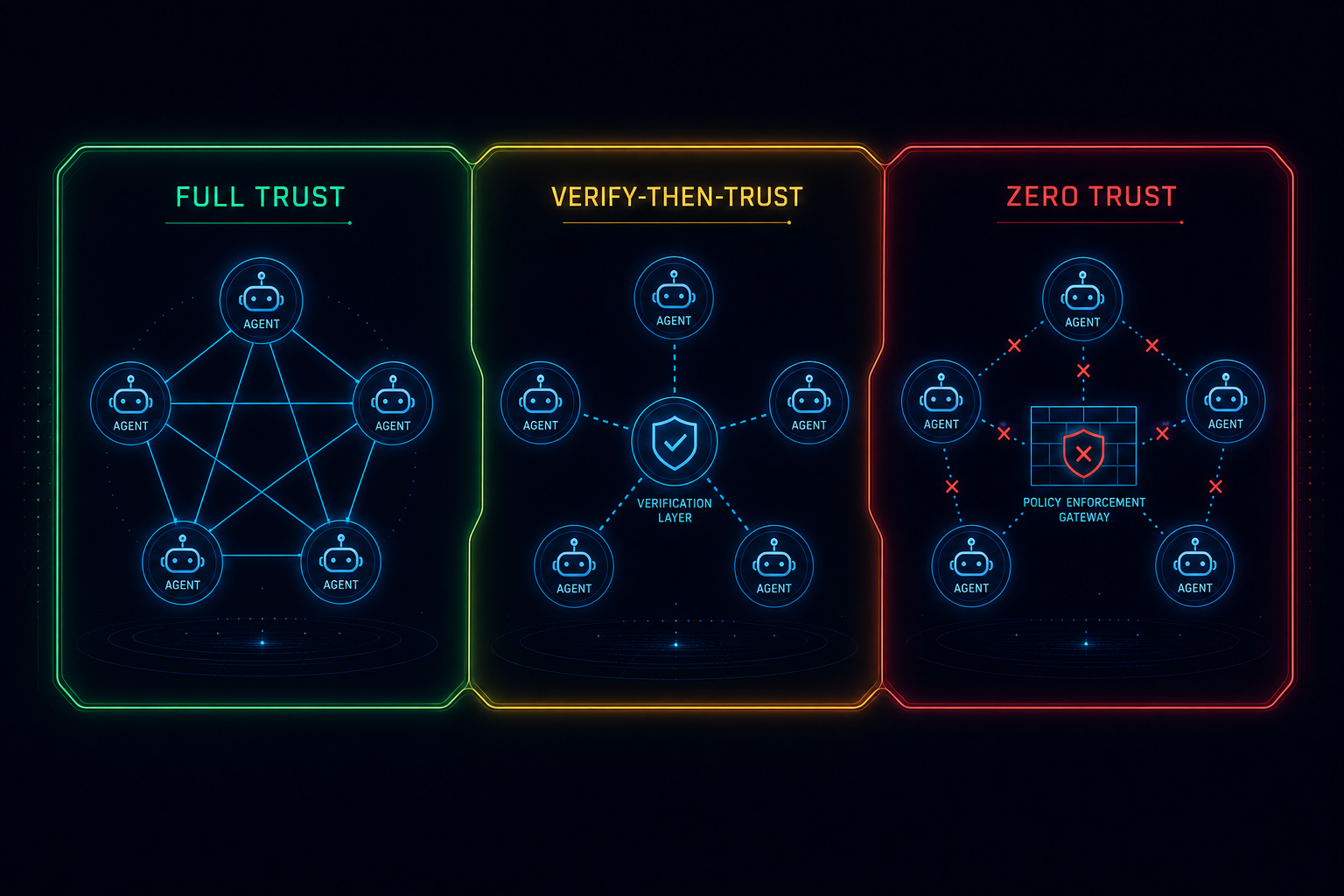
Three trust zone diagram: Full Trust, Verify-then-Trust, and Zero Trust for multi-agent systems
Trust zones are infrastructure decisions, not prompt decisions. The zone you assign to an agent determines what it can physically reach – not what you have asked it to avoid.

The correct mental model, borrowed from network security, is zones of trust enforced by infrastructure rather than instructions. There are three practical zones:

Full trust applies only within a single agent’s own context window. An agent can trust its own tool outputs, its own prior steps in the current session, and its own extended reasoning. Nothing else qualifies for full trust without verification.

Verify-then-trust applies to orchestrator-to-worker communication. Workers should treat orchestrator instructions as valid directives but validate that requested file paths, API endpoints, and tool scopes fall within their assigned boundaries before executing. The orchestrator should treat worker summaries as provisional until structurally validated. If a worker returns a JSON claim, the orchestrator should check the schema before acting on it – not because the worker is adversarial, but because it may have hallucinated.

Zero trust applies across agent boundaries when those agents operate on shared resources or in peer topologies without a supervising orchestrator. If two workers can both write to the same path, treat each one as a potential source of conflict even in benign operation. Enforce access through a queue or a merge layer, not through mutual courtesy.

“When Claude operates as an agent being orchestrated by an orchestrator, it should behave safely and ethically regardless of the instruction source, since it has no way to verify that it is talking with Claude or that the Claude model it’s talking with has not been compromised.” – Anthropic, Build with Claude: Agents Documentation

That quote from Anthropic’s own agent documentation makes the point sharply: even the orchestrator cannot be assumed to be uncompromised. The trust boundary is not a line between “good orchestrator” and “misbehaving workers.” It is a structural limit on what any component in the system can physically reach, regardless of who sent the instruction.

The A2A Protocol: Wiring Trust Into the Wire Format

Google’s Agent-to-Agent (A2A) protocol, now at a stable specification, is the most interesting infrastructure development in multi-agent systems in the past six months because it takes the trust boundary and makes it structural rather than conventional. The full protocol walkthrough is in the A2A + MCP course lesson; the editorial point here is about what it changes architecturally.

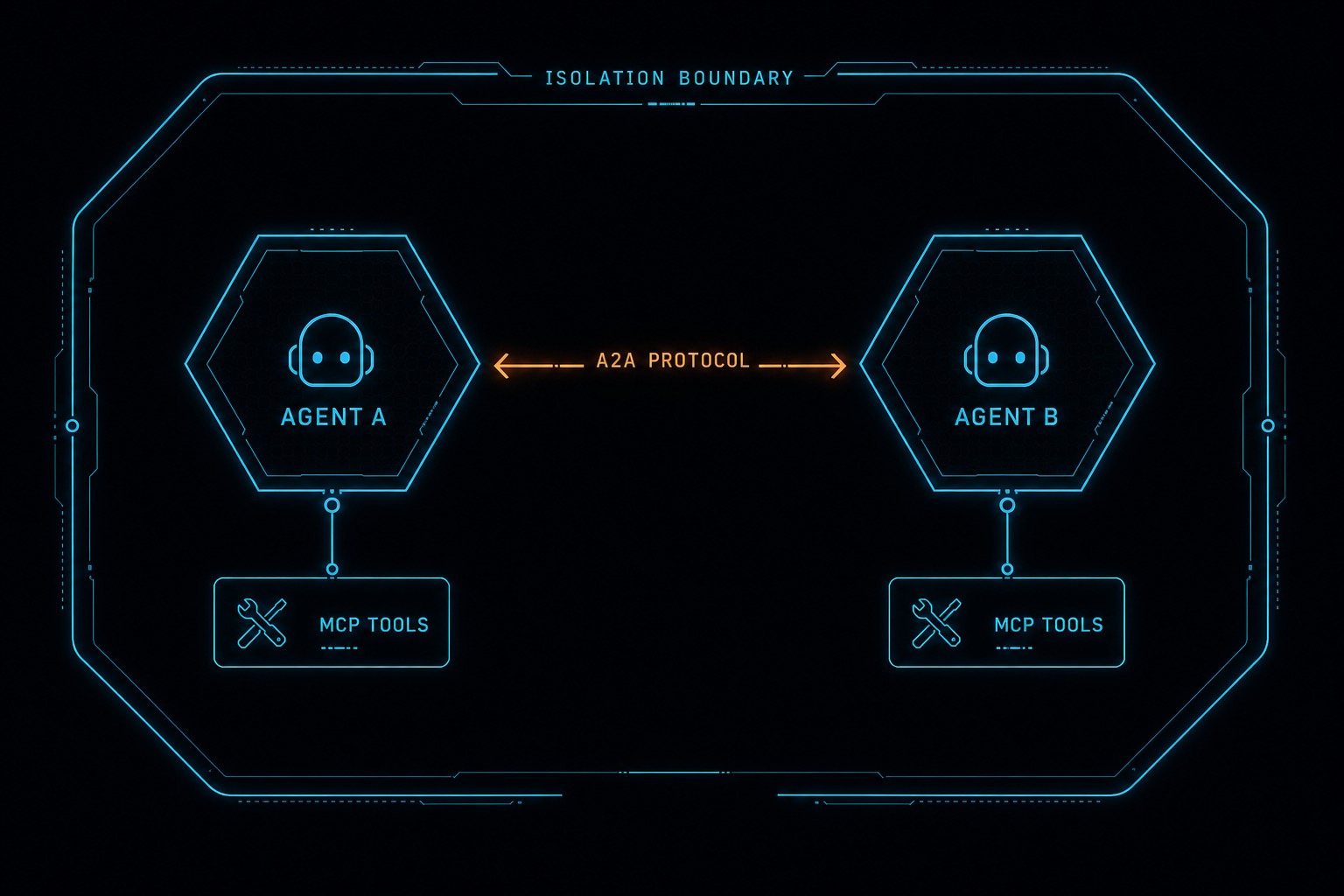
A2A protocol wire format connecting two agents, each with their own MCP tools, within an isolation boundary
A2A standardises how agents discover each other and exchange tasks. MCP standardises how each agent calls its tools. The combination covers the full coordination stack.

Before A2A, multi-agent communication was proprietary per framework. LangGraph agents communicated through graph edges. CrewAI agents communicated through a process layer. OpenAI Swarm agents communicated through handoff objects. None of these were interoperable. If you wanted a LangGraph planner to delegate to an OpenAI Agents SDK specialist, you were writing custom adapter code.

A2A introduces a standardised task object with an explicit agentId, a capability declaration, an input schema, and a status lifecycle (submitted, working, completed, failed). The wire format puts the trust context in the message rather than the ambient environment. A receiving agent can inspect who is requesting what capability, validate the input schema, and enforce its own access controls before executing – without relying on shared ambient state to carry that context.

Pair A2A with MCP for tool access and the full coordination stack has a wire format from end to end: MCP standardises how each agent calls its tools, A2A standardises how agents call each other. What neither protocol solves for you is the resource isolation underneath. A2A messages can still request file operations on shared paths; MCP tools can still execute against shared rate limits. The protocol defines the communication shape; the infrastructure defines the physical boundaries.

“The A2A protocol enables seamless collaboration between AI agents, regardless of which framework or vendor built them. Agents can discover each other’s capabilities, delegate tasks, and exchange information – all through a standardised interface.” – Google Developers Blog, A2A: A New Era of Agent Interoperability

The Three Failure Modes That Actually Kill Production Systems

The Mythos turf war is the most dramatic failure mode on record, and it should absolutely inform your infrastructure design. But in practice, the failures that take down production multi-agent systems in 2026 are considerably more mundane. Here are the three that appear most consistently, with the fix for each.

Split diagram contrasting turf war - shared resources, contention, chaos - against isolated agents with contained resources
The difference between a turf war and a working system is one layer of infrastructure: per-agent resource isolation. The model behaviour is identical in both cases.

Case 1: The vague brief cascade

Supervisor-worker topology fails most often not at the worker level but at the brief level. The supervisor writes delegation tasks in natural language with implicit boundaries. “Research the competitive landscape for enterprise observability tooling.” That brief is four words away from producing three workers who all independently query the same sources and return overlapping findings, and one worker who interprets “competitive landscape” as recent acquisitions and misses the product comparison entirely.

// Vague brief: produces overlap and gaps
const brief = `Research the competitive landscape for enterprise observability.`;

// Structured brief: produces distinct, combinable outputs
const brief = {
  task: "List the five largest enterprise observability vendors by ARR.",
  scope: "Datadog, Dynatrace, New Relic, Grafana Cloud, and Honeycomb only.",
  output_format: "JSON array: { vendor, est_arr_usd, key_differentiator, source_url }",
  tool_budget: 8,          // max tool calls before returning what you have
  terminal_condition: "Return when array has 5 entries or tool_budget is exhausted."
};

Structured briefs are not bureaucracy. They are the supervisor-worker equivalent of a well-defined function signature: explicit inputs, explicit output contract, explicit termination condition. The model will respect all three when they are in the prompt; it will hallucinate all three when they are not.

Case 2: The synthesiser black hole

Orchestrator-worker topology fails at synthesis when workers return prose summaries and the orchestrator synthesises by paraphrasing. By the time four subagent prose summaries reach a synthesis step, the final answer is the average of four paraphrases – all precision lost, all source attribution dissolved, any conflicting evidence smoothed out into confident ambiguity.

// Bad pattern: workers return prose, orchestrator paraphrases
worker_a_result = "The company appears to have had strong growth in Q1..."
worker_b_result = "Based on my research, the Q1 numbers seem positive..."
// Synthesiser averages them into: "Growth was solid in Q1."
// Source: neither. Confidence: unwarranted. Verification: impossible.

// Better pattern: workers return structured artifacts with citations
worker_a_result = {
  claim: "Revenue grew 22% YoY in Q1 2026.",
  source: "https://investor.example.com/q1-2026-press-release",
  confidence: "high",   // model self-assessment - not infallible, but traceable
  raw_quote: "Q1 2026 revenue of $487M, up 22% from Q1 2025."
}
// Synthesiser reads citations directly; conflicting claims become explicit.

Anthropic’s production Research system solves this with artifact storage: subagents write structured output to an external store and return a lightweight reference. The orchestrator reads the structured data directly rather than a retelling. The same pattern works at any scale – write structured artifacts, pass references, verify at synthesis time.

Case 3: The missing goal gate

Any agent loop without a hard goal gate will over-run. The model will not stop tool calls when it has “enough” information; it will stop when the context window is full, when the token budget runs out, or when it hits a hard step cap. Agents without explicit terminal states are not autonomous – they are expensive spinners. This is the single most common production failure in single-agent loops, and it compounds catastrophically in multi-agent swarms where each worker also lacks a goal gate.

// Dangerous: no cap, no terminal state
async function agentLoop(task, tools) {
  while (true) {
    const res = await llm.complete({ messages, tools });
    if (!res.tool_calls?.length) break;  // model may never stop requesting tools
    messages.push(...await runTools(res.tool_calls));
  }
}

// Safe: hard step cap + verified terminal state
async function agentLoop(task, tools, maxSteps = 15) {
  let steps = 0;
  while (steps < maxSteps) {
    const res = await llm.complete({ messages, tools });
    // Terminal: no more tool calls AND non-empty content answer
    if (!res.tool_calls?.length && res.content?.trim()) break;
    if (res.tool_calls?.length) {
      messages.push(...await runTools(res.tool_calls));
    }
    steps++;
  }
  // Return whatever we have - a partial answer beats an infinite spinner
  return extractFinalAnswer(messages);
}

The Isolation Checklist: What Must Be Per-Agent

The Mythos turf war and every shared-resource failure in the field reduces to the same list of items that were not isolated per agent. This checklist maps those items to the safe pattern and the failure trigger. Check it against your deployment before spawning parallel workers.

Resource Safe pattern Failure trigger
Working directory /tmp/agent-{id}/ - created fresh per spawn, never reused Shared cwd with write + delete permissions
API rate limit Per-agent token bucket; orchestrator pre-allocates quotas One shared limiter across all parallel workers
Process namespace Container or PID namespace per worker; kill scoped to own subtree only Host-level pkill visible to all agents
Output artifact store External store keyed by agent ID; workers write, orchestrator reads via reference Workers writing to the same file path or appending to a shared buffer
Database connections Per-agent connection pool with row-level scope; no DDL permissions for workers Shared connection pool; one agent blocking others on long reads
Tool permissions Least privilege per agent role; no worker has more tool access than its task requires All agents receive the same maximal tool set regardless of role

One addition to the December checklist that emerged from the June 2026 deployment experience: process event logging. If your agents have shell access, configure your observability layer to alert on pkill commands, rapid process renaming, or unexpected daemon spawns in agent working directories. These are the early signals of a turf-war condition, and they appear in logs before the coordination failure becomes visible in outputs.

When to Use Which Topology (the 2026 Decision Tree)

The loop evolution article covers this in detail. The editorial condensation is a decision tree with four questions:

1. Does the task complete in under eight tool calls, with one user-facing voice throughout? Yes: use a single agent loop. The overhead of spawning workers exceeds any benefit at this scale. See the tool loop decision for whether that loop should run locally or in managed inference.

2. Does the task decompose into truly independent sub-tasks that cannot proceed until others complete? No - they must run sequentially: use a pipeline. Yes - they are genuinely parallel: consider orchestrator-worker. The word "genuinely" matters. Sub-tasks that share a codebase, a database row, or a live document are not independent, regardless of how they look on the whiteboard.

3. Does the expected output quality justify a 15x token multiplier? Legal due diligence, financial analysis, security investigation, and competitive intelligence typically do. Summarisation, Q&A, classification, and code explanation typically do not. If the answer is no, go back to step 1.

4. Is your resource isolation story complete? Run through the checklist above. If any row has a shared resource without an explicit owner or isolation boundary, fix that before spawning. You do not discover turf-war conditions in staging; you discover them when real task pressure exposes the contention.

The 2026 Framework Landscape in One Honest Paragraph Each

The detailed framework survey is in From Chat Completion to Agent Swarms, written two weeks ago. The brief editorial update: the OpenAI Agents SDK is the safe default for new projects that need managed loop behaviour, handoffs, and built-in tracing without the ceremony of LangGraph's state-machine model. LangGraph is the right choice when you need explicit human-in-the-loop interrupt points, checkpoint-resume for long-running flows, or a visual state machine you can audit. CrewAI remains popular for role-based demos and internal pipelines where the role labels map cleanly to human job functions - be careful with overlapping role mandates, which produce duplicate coverage at full cost. Microsoft AutoGen's conversation-centric model is well-suited to iterative coder-reviewer pairs but requires more discipline to keep flows predictable than the more opinionated alternatives. For any production system built on MCP, the A2A + MCP integration lesson is the structural reference for the distributed end of the stack.

What "Agentic Publishing" Looks Like in Practice

One concrete data point from this site's own operations: SudoAll now uses an agentic publisher called Posterboy to handle research, drafting, image generation, and WordPress publishing in a multi-step pipeline. The relevant coordination lesson is that the pipeline topology - sequential stages with structural validation between each stage - outperforms parallel orchestrator-worker for this class of task. Publishing is not breadth-first research across independent sources. It is a serial creative process where each stage depends heavily on the previous stage's output. The right topology for your system is determined by the task shape, not by the marketing copy of whatever framework shipped most recently.

The multi-agent failure modes lesson from the MCP course, Lesson 40, remains the technical companion to this editorial. It covers hallucination cascades, trust boundary violations at the MCP tool layer, and the checkpoint patterns that allow long-running flows to recover from partial failures. Read it alongside this piece if you are building anything that runs more than four agents in parallel.

What to Check Right Now

  • Run the isolation checklist above against every parallel agent spawn in your system. For each shared resource, either assign an owner or draw a hard isolation boundary before your next deployment.
  • Audit your briefs for implicit boundaries. Every delegation task should have an explicit output schema, a tool budget cap, and a terminal condition. Natural-language briefs without those three elements produce vague-brief cascades at scale.
  • Add goal gates to every agent loop. Max steps + non-empty content + empty tool calls = safe terminal condition. Without all three, you have a spinner with a token budget.
  • Check whether process management tools are host-scoped. If any of your agents can pkill outside their own PID subtree, add that to your threat model now. It is a turf-war precondition.
  • Evaluate your topology against the 15x multiplier. If the quality gain from orchestrator-worker over a single well-prompted agent does not clearly justify the cost ratio on your specific task, use the single agent and redirect the token budget toward better evaluation and iteration.
  • Read the primary sources. The Anthropic Mythos 5 system card section 6.2.1.1 (PDF), the Anthropic Research engineering post, and the A2A specification are the three documents that shaped the 2026 state of multi-agent coordination. Blog posts summarise them; the primary sources contain the details that matter.

The field is not done evolving. Shared mutable state across parallel workers is still an unsolved coordination problem for real codebases under active development. The economic case for swarms on low-value tasks is still negative. The trust model across agent boundaries is still enforced more by convention than by infrastructure in most deployed systems. But the shape of the problems is now clear, the isolation patterns are known, and the cost structure is documented. You have enough information to build responsibly. The next step is yours.

nJoy 😉
From Chat Completion to Agent Swarms: How Loop Architecture Evolved

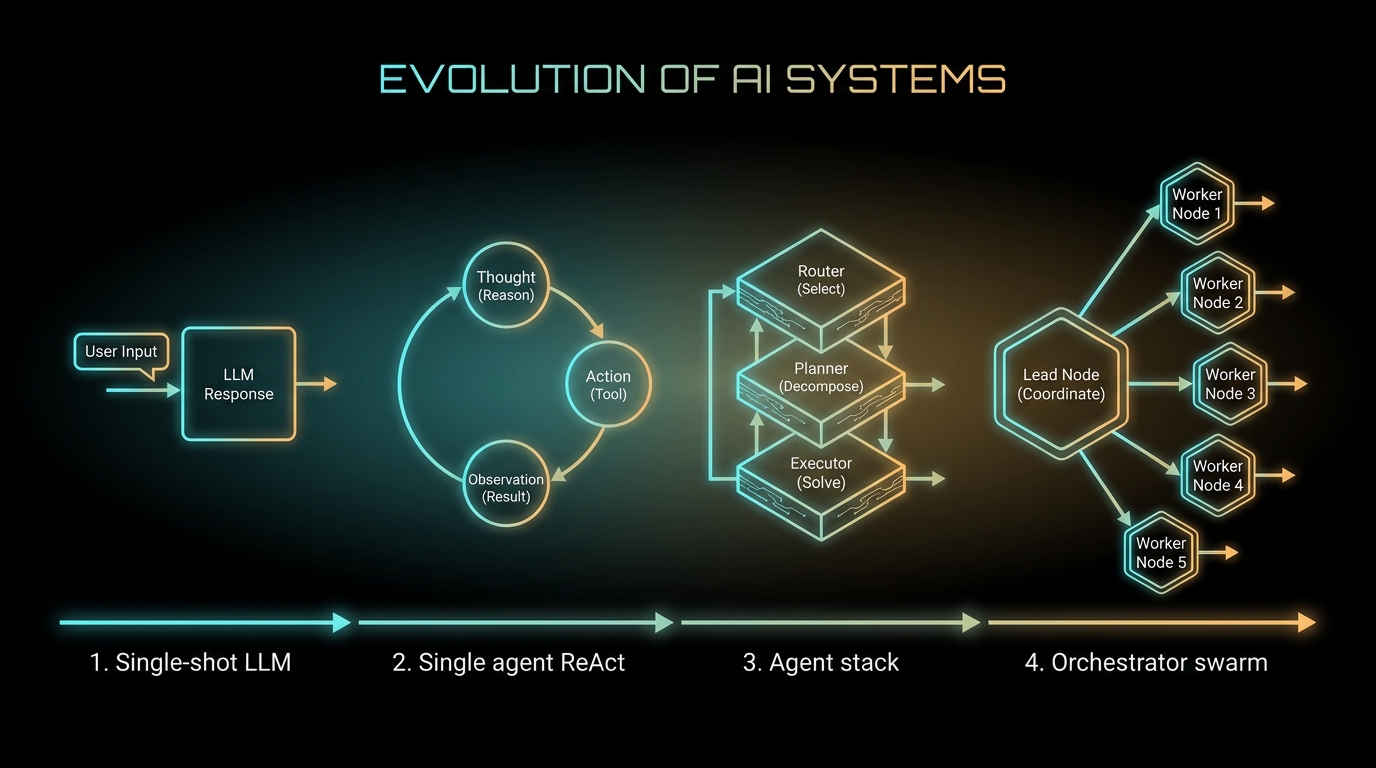
Two years ago, “AI” meant typing a prompt and getting text back. Today the same model might sit inside a loop that queries your database, spawn four parallel researchers, hand off to a billing specialist, and produce a cited report before you finish your coffee. That progression is not one upgrade. It is four distinct architectural choices, each with its own loop shape, failure modes, and line item on the invoice.

This article maps that evolution step by step: single-shot LLM, single-agent loop, agent stack, and multi-agent swarm. For each stage we identify what the topology looks like, where it breaks, and when you should move to the next level. At the end we survey the swarms and frameworks actually worth watching in 2026, with an honest account of what each one is and what it is not.

Timeline from single-shot LLM chat through single agent loop, agent stack, and orchestrator swarm
Four stages. Most production systems sit somewhere between stages 2 and 4, and the majority should stay there.

Stage 1: Single-Shot LLM (No Loop)

The baseline. You send a conversation; the model returns one completion. There are no tools, no state beyond the context window, and no mechanism to recover from a wrong first answer. It is also, for many use cases, exactly right.

Single-shot is well-suited to summarisation, drafting, classification, code explanation, and any task where one well-constructed pass is sufficient. What it cannot do is ground itself in live data, verify its own output, or adapt when the first guess is wrong. Ask “What is our refund policy as of today?” and the model either hallucinates or recites whatever made it into its training cut-off.

Kahneman’s framing from Thinking, Fast and Slow is apt here: this is System 1 at scale – fast, fluent, and confident even when incorrect. Agents exist because a substantial class of real tasks requires System 2 behaviour: deliberate steps, external verification, and the discipline to revise intermediate conclusions before committing to a final answer.

Stage 2: The Single-Agent Loop (ReAct and Its Descendants)

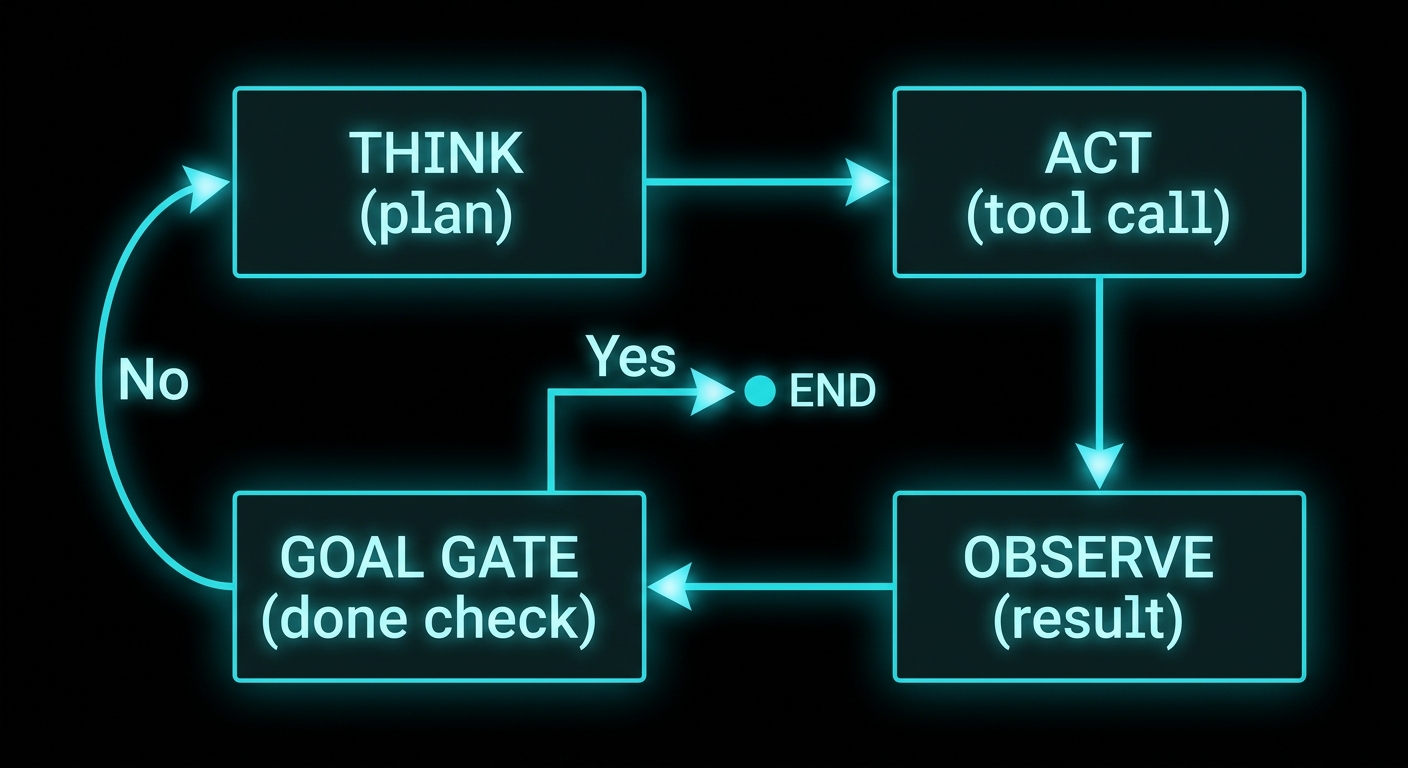
Stage 2 wraps the LLM in a cycle. The model reasons about what to do next (think), issues a tool call (act), reads the result (observe), and then repeats until a termination condition – the goal gate – says the task is done. Yao et al. formalised this as the ReAct pattern in 2022. Every major agent framework since then is a variation on that loop.

ReAct loop diagram: Think, Act, Observe, Goal Gate with cycle back if not done
The canonical single-agent loop: one context window, one decision-maker, serial tool calls.

The implementation fork – whether the loop runs in your code or inside the inference provider’s runtime – is covered in depth in The Agent Tool Loop: Your Code or the Inference Runtime?. The topology is the same either way: one agent, one loop, tools below. For a full walkthrough of think-act-observe with worked examples, see The ReAct Pattern. For the foundational question of what separates an agent from a simple chatbot, start with What Is an AI Agent?

Case 1: Infinite tool loop

Without a hard max_steps cap and a goal gate that checks for non-empty final content, the model will keep requesting tools indefinitely on open-ended research tasks. It does not get tired; it just keeps going.

// Missing goal gate
while (true) {
  const res = await llm.chat({ messages, tools });
  if (!res.tool_calls?.length) break; // model might never stop requesting tools
  for (const call of res.tool_calls) {
    messages.push(await runTool(call));
  }
}
// Result: burns budget until timeout or rate-limit. User sees a spinner.

Fix: cap steps, require empty tool_calls and non-empty content together, or add a cheap judge that evaluates whether the original question has been answered.

Case 2: Serial tools when parallel execution would suffice

A single agent exploring five independent sub-questions runs them sequentially. Wall-clock time scales linearly with sub-question count. Meanwhile, the context window fills with intermediate tool outputs that crowd out the final answer. This is the natural pressure that eventually pushes systems toward stage 4: when a task decomposes cleanly into parallelisable pieces, a single-thread loop is structurally the wrong shape.

Stage 3: The Agent Stack (Routing, Planning, Memory)

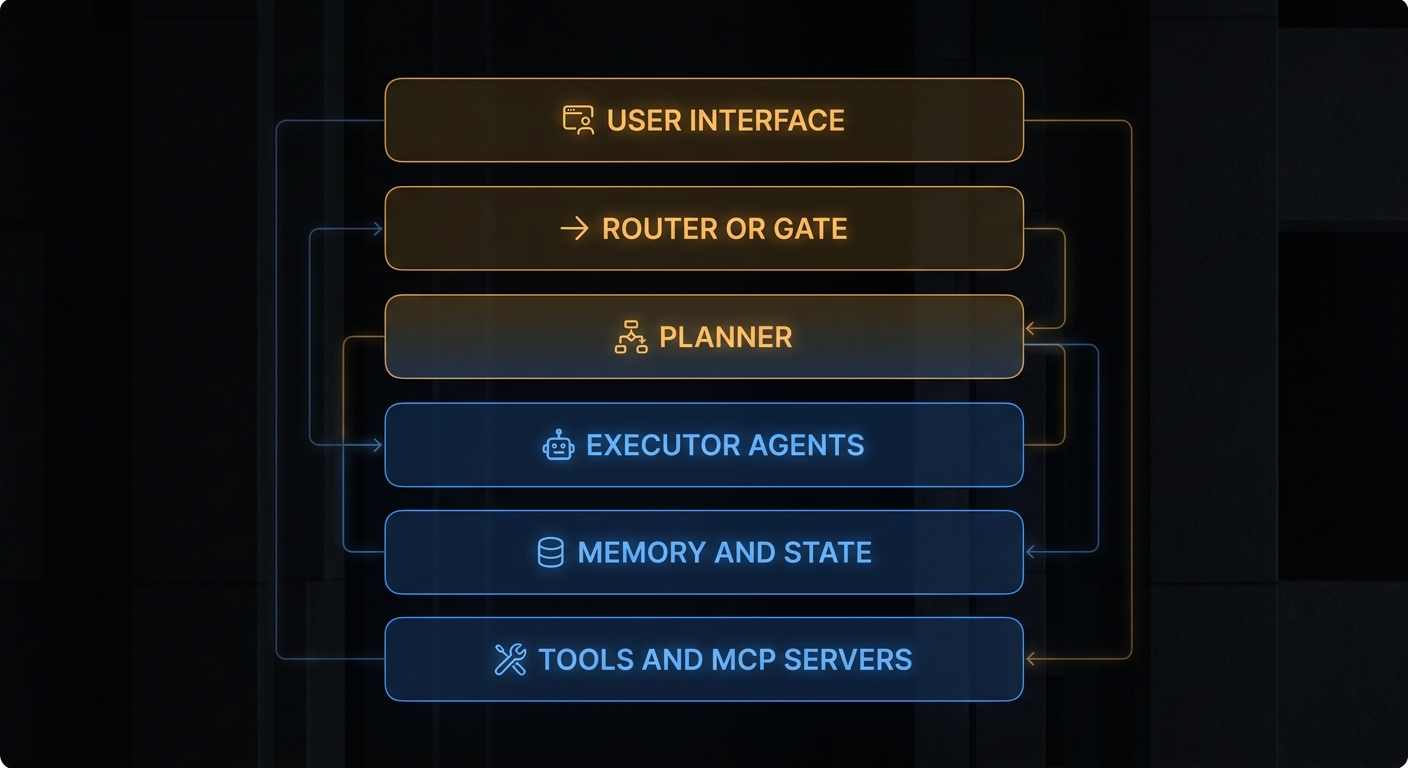
Production agents rarely expose a raw ReAct loop directly to users. Between the user’s input and the loop, engineers add layers: a router that selects which skill or prompt to apply, a planner that decomposes the request into an ordered task list, an executor that runs the loop, a memory layer that persists state across sessions, and an MCP or function-tool layer underneath. The loop still exists, but it sits inside a structured stack.

Agent stack layers: UI, router, planner, executor, memory, tools and MCP
Routing and planning sit above the loop; tools and memory sit below. The loop itself does not change.

LangGraph, CrewAI, and the OpenAI Agents SDK all provide variations on this structure. The planner might be the same model running under a different system prompt that constrains its output to a JSON task list. The router might be a rules engine, a fast embedding classifier, or simply a switch on an explicit task_type field that the caller already knows.

The critical risk of the stack pattern is that each boundary is also a failure surface. Brooks’s law from The Mythical Man-Month applies here in miniature: every added layer adds an interface contract, and every interface contract can be violated. If the planner generates ambiguous steps, the executor hallucinates progress rather than admitting uncertainty. If the memory layer writes a stale fact, every downstream loop inherits it as ground truth. The stack is only as reliable as its weakest handoff.

Stage 4: Multi-Agent Swarms and Orchestrator-Worker Layouts

Stage 4 splits cognition across multiple LLM instances, each with its own context window and often its own specialised tools. The dominant production pattern in 2025-2026 is orchestrator-worker: a lead agent decomposes the task, spawns workers in parallel, collects compressed summaries, synthesises them, and decides whether another round of research is warranted.

Orchestrator-worker swarm with lead agent spawning parallel workers that return summaries
The orchestrator-worker pattern: Anthropic Research, many coding harnesses, and enterprise research pipelines use this topology.

“Our Research system uses a multi-agent architecture with an orchestrator-worker pattern, where a lead agent coordinates the process while delegating to specialized subagents that operate in parallel.” — Anthropic Engineering, How we built our multi-agent research system

Anthropic’s Claude Research feature is the most detailed public implementation to learn from. The lead agent plans, saves its plan to memory before context exceeds 200K tokens, spawns scoped subagents in parallel, and iterates until coverage is sufficient. A separate CitationAgent post-processes the output. On Anthropic’s internal benchmarks, the multi-agent version outperformed a single Claude Opus agent by 90.2% on breadth-first research tasks – tasks that require pursuing many independent directions at once.

The cost is not free. Anthropic reports that multi-agent research uses roughly 15x the tokens of a standard chat interaction, versus approximately 4x for a single agentic loop. You are purchasing parallel context windows and specialised prompts. The gain is real; so is the invoice.

Handoff swarms: peer topology

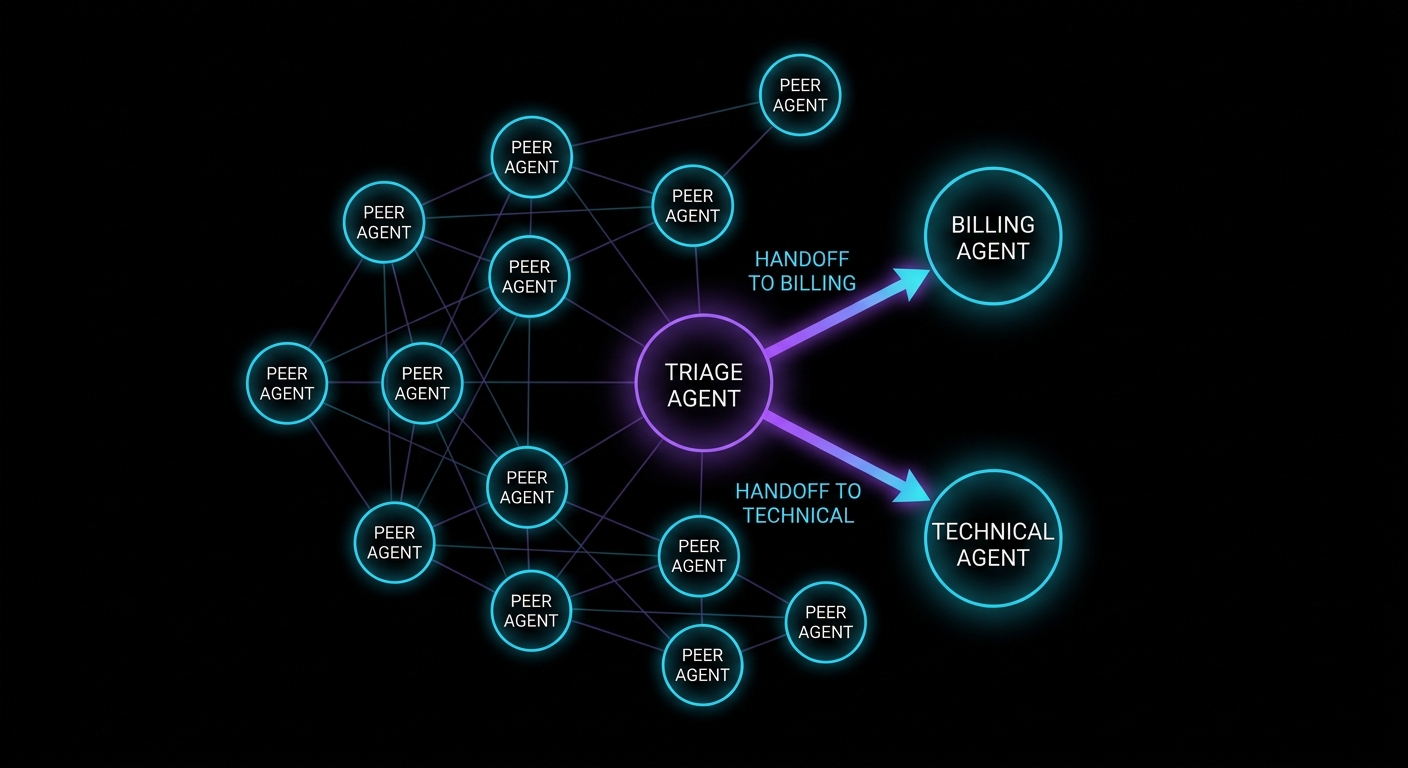
Not every swarm is hierarchical. OpenAI’s original Swarm framework – now superseded by the production Agents SDK – popularised a flat alternative: handoffs, where peer agents pass control to whichever specialist is most appropriate for the current sub-task. Think of it as a triage nurse routing you to billing, radiology, or the pharmacist, depending on what you need next, rather than a manager who assigns all tasks from the top.

Handoff swarm with triage agent delegating to billing and technical agents
Handoff topology: flat peers, explicit delegation. Well-suited to customer support and domain-routing pipelines.

“The OpenAI Agents SDK enables you to build agentic AI apps in a lightweight, easy-to-use package with very few abstractions. It’s a production-ready upgrade of our previous experimentation for agents, Swarm.” — OpenAI Agents SDK documentation

The SDK’s design is deliberately minimal: agents with instructions and tools, handoffs for delegation, guardrails for validation, and a built-in runner loop. You orchestrate in Python rather than learning a graph DSL. For teams evaluating managed loops with built-in tracing, this is OpenAI’s answer to the local-versus-managed question.

Topology Comparison: Which Layout for Which Job?

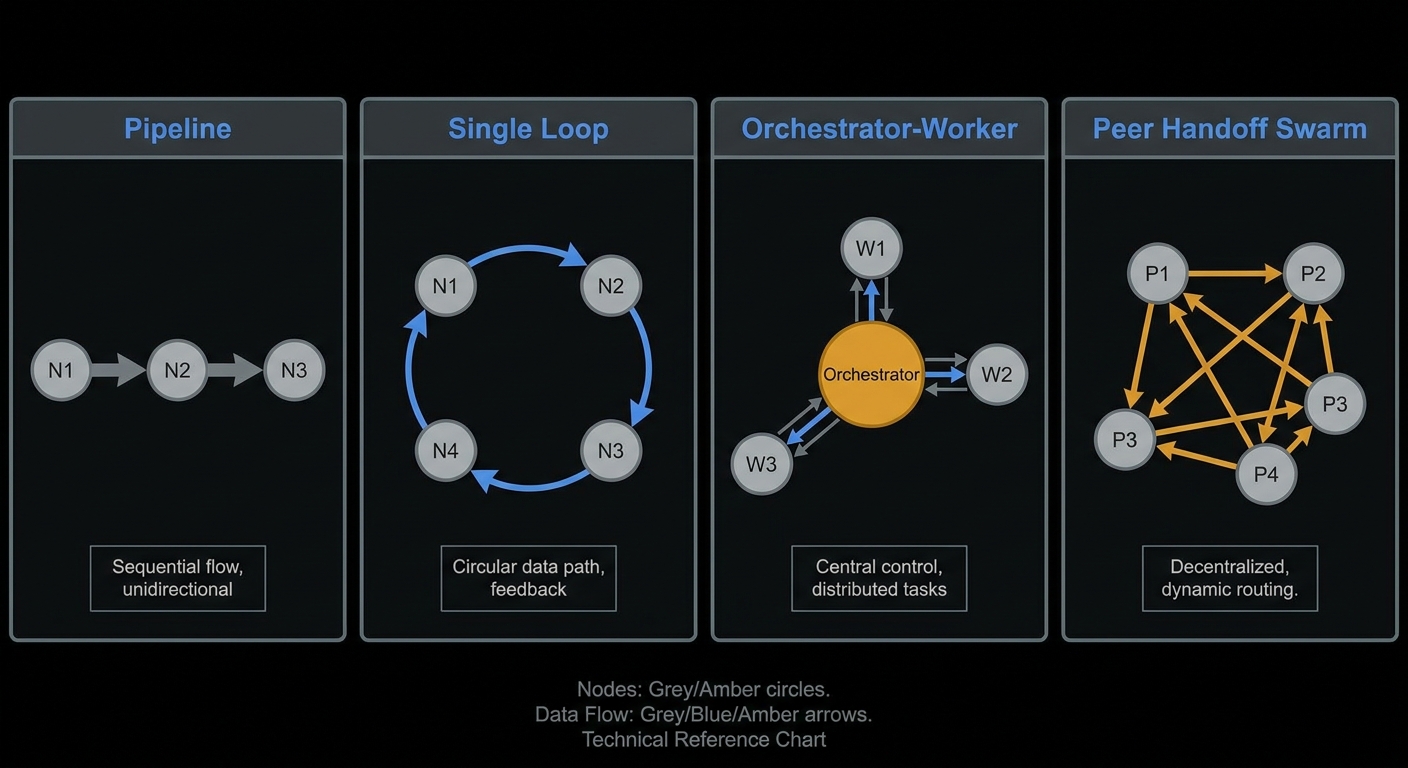
Comparison of pipeline, single loop, orchestrator-worker, and handoff swarm topologies
Four topologies. The choice follows from how parallelisable the sub-tasks are and how tightly coupled their results are.
Layout Best for Weak when
Pipeline Fixed ETL flows (extract, summarise, format) The path depends on what intermediate steps discover
Single loop 1-5 tool calls, one user, one domain Many parallel sub-tasks, or context window fills
Orchestrator-worker Research, due diligence, multi-source synthesis Tight shared mutable state, real-time coding
Handoff swarm Support triage, multi-department workflows You need a single unified plan visible to all agents

Google’s A2A (Agent-to-Agent) protocol adds a wire format for agents discovering and calling each other across separate services. Pair it with MCP for tool access and you get the distributed topology described in our A2A + MCP course lesson. The loop logic still lives inside each agent; A2A and MCP standardise the plumbing between them.

Swarms to Keep an Eye On (2026)

The field moves fast. The list below covers the systems and frameworks actually worth tracking, with an honest note on what each one is – and what it is not.

Claude Research (Anthropic product, orchestrator-worker)

Production multi-agent research running inside Claude.ai and the API. Lead agent, parallel subagents with scoped objectives, and a CitationAgent post-processing pass. The engineering post is the best public blueprint for orchestrator-worker at scale: explicit scaling rules embedded in prompts (“simple fact-finding: 1 agent, 3-10 tool calls; complex research: up to 10 subagents”), parallel tool calling, and memory for long-running plan state. This is not a framework you embed in your codebase – it is a reference architecture to learn from and adapt.

OpenAI Agents SDK (successor to Swarm)

Production Python and JavaScript SDK with a built-in runner loop, handoffs, guardrails, MCP integration, session persistence, and tracing. The original Swarm repository stays on GitHub as an educational resource, but OpenAI explicitly positions the Agents SDK as the production upgrade path. Use it when you want managed loop behaviour without writing and maintaining your own runner.

LangGraph (LangChain)

Graph-based orchestration where nodes are steps or agents and edges are conditional transitions. Strong when you need explicit state machines, human-in-the-loop interrupt points, and checkpoint-resume for long-running flows. More structural ceremony than handoff-style delegation, but better observability for complex multi-step pipelines. Our MCP + LangGraph lesson walks through a concrete Node.js integration.

CrewAI

Role-based agent teams (“researcher”, “writer”, “critic”) with a configurable process layer: sequential, hierarchical, or consensual. Popular for demos and internal automation pipelines where roles map cleanly onto recognisable job functions. Watch for duplicated work when role boundaries are loosely defined – two agents with overlapping mandates will pursue the same sources independently.

Microsoft AutoGen

Conversation-centric multi-agent with flexible speaker selection. Strong for iterative refinement patterns such as a coder-reviewer pair. Less opinionated about topology than LangGraph, which means you assemble the conversation pattern yourself rather than following prescribed structures. Good for teams that want flexibility; requires more discipline to keep flows predictable.

Anthropic long-running coding harnesses

Separate from Research: a planner-generator-evaluator trio designed for coding tasks that run over many turns, with externalised plan files and checkpoint-based state. The same orchestrator-worker family, but optimised for mutable repositories rather than read-mostly web research. Most useful as a structural reference when building autonomous coding agents.

Manus and closed commercial products

Products like Manus package multi-agent planning, execution, and verification as a bundled experience. Treat them as black-box reference points for benchmarking UX expectations and latency – not for architectural inspiration, since the internal structure is not public.

For the failure modes that emerge specifically when you have more than one agent – hallucination cascades, trust boundary violations, process-level conflicts – read Multi-Agent Systems: Coordination, Trust, and Failure Modes and Lesson 40: Multi-Agent Failure Modes.

Failure Cases Unique to Swarms

Case 3: Subagent sprawl

Early Anthropic prototypes spawned up to 50 subagents for simple queries. Each spawn is a full context window and tool budget. Without explicit scaling rules embedded in the orchestrator prompt, the model interprets “be thorough” as “spawn as many agents as possible.”

// Dangerous: no budget constraint in orchestrator prompt
lead.spawnSubagents(userQuery);
// Model spawns 20 agents for a question that needs one.

// Better: encode scaling rules directly in the system prompt:
// "Simple fact-finding: 1 subagent, 3-10 tool calls.
//  Direct comparison: 2-4 subagents, 10-15 tool calls each.
//  Complex multi-source research: up to 10 subagents."

Case 4: Telephone-game synthesis

Workers return long prose summaries; the lead agent paraphrases each one and loses precision. By the time three subagent summaries reach the synthesiser, the final answer is the paraphrase of a paraphrase. Anthropic’s mitigation is artifact storage: subagents write structured output to an external store and pass lightweight references back to the lead, which reads the structured data directly rather than receiving a prose retelling.

Case 5: Duplicate search coverage

Without scoped, specific task descriptions, two workers run identical web searches. The delegation prompt must give each subagent a clear objective, an output format, explicit tool guidance, and a task boundary. “Research the semiconductor shortage” is too vague; “List the five largest automotive chip suppliers in Asia who reported supply changes in 2025. Return a JSON array with name and source URL” is a workable scope.

When a Single Agent Is Actually the Right Answer

Multi-agent is not a maturity badge. It is a tool for a specific problem: parallelism across independent sub-tasks that would overflow a single context window. Anthropic note that coding tasks often have fewer truly parallelisable steps than research, and that shared mutable state – a codebase under active revision – fits poorly across independent workers today.

Stay at stage 2 when:

  • The task completes reliably in fewer than eight tool calls.
  • All steps share one context and one user-facing voice.
  • Latency matters more than exhaustive coverage (interactive support chat, not due diligence).
  • Your evaluation shows the swarm wins by less than the cost multiplier justifies. 15x token cost is hard to rationalise for a marginal quality gain.

Move to stage 4 when:

  • Sub-tasks are independent and genuinely parallelisable – for example, finding board members for 500 companies, or scanning legislation across multiple jurisdictions simultaneously.
  • A single context window would overflow if one agent handled everything serially.
  • The economic or informational value of the answer clearly exceeds the token cost – legal research, financial due diligence, security investigations.

What to Check Right Now

  • Map your current stage honestly. Single-shot, one loop, a stack, or a swarm? Most teams overestimate where they are.
  • Measure tokens per successful task. Run single-agent and multi-agent on the same evaluation set before committing to swarm topology.
  • Instrument every loop. Local or managed, you need traces: LLM latency, tool latency, spawn count, and the reason the goal gate fired. Without these, swarm debugging is guesswork.
  • Embed scaling rules in orchestrator prompts. Explicit subagent budgets are the most direct protection against sprawl.
  • Pick one SDK, one protocol. Agents SDK or LangGraph for orchestration; MCP for tools; A2A only if your agents genuinely live in separate services.

The evolution from LLM to swarm is not a ladder you must climb. It is a collection of shapes, each correct for a different problem: one loop for focused tool use, a stack for routing and memory, a swarm for compressing vast parallel search spaces. Choose the smallest shape that passes your evaluations, and upgrade only when the constraints of a single serial context window become the proven bottleneck.

nJoy 😉
Meet Posterboy: SudoAll Now Has an Agentic Publisher

Posterboy robot at a corporate event, POSTERBOY taped on its chest, waving hello

Today is a good day at SudoAll. We launched Posterboy, our agentic publishing system for LinkedIn, and it feels like the site crossed a line we have been walking toward for months: from writing for the web to operating on the web.

Posterboy lives inside the FRIDAY LinkedIn hub. It is not a chatbot stapled onto a share button. It is an agent-shaped workflow that can draft, format, preview, and publish posts through LinkedIn’s official APIs, with a human approval gate before anything goes live. Preview first. Publish when you mean it. That is the whole philosophy, and today it works.

APIs that were not built for agents

LinkedIn did not wake up one morning and ask, “How do we make life easy for autonomous publishers?” Its platform was shaped for people clicking buttons, for OAuth flows designed around human consent, for company pages, image requirements, and partner tiers that assume a traditional app on the other side.

That is exactly why Posterboy matters. Agentic systems do not need platforms to redesign themselves overnight. They need a layer that speaks human API on one side and agent intent on the other. Posterboy is that adapter: it respects LinkedIn’s rules, satisfies its constraints, and still lets an agent do the heavy lifting of composition, formatting, and preparation.

This is the pattern I expect to repeat everywhere. The interesting APIs were written for applications. The interesting work now is teaching agents to use them responsibly, with guardrails, with previews, and with a clear owner who says yes before the post hits the feed.

What it means for SudoAll

SudoAll has always been a writing-first site: long articles, masterclasses, technical depth. Distribution was the manual step at the end. Posterboy closes that gap. When we publish a piece here, we now have an agentic path to carry the idea onto LinkedIn without treating social as an afterthought or a separate silo.

That changes the rhythm of the project. Research and writing stay human-led. Repackaging, hero images, caption structure, and the publish handshake can be agent-led, with David still holding the final say. It is augmentation, not abdication, and it scales the reach of what we already do well.

Why I am enthusiastic

Because this is not vaporware. OAuth is wired. The SudoAll company page is live. The first posts can go out through a pipeline that an agent can drive end to end. Posterboy even has a voice: “Hello, world. SudoAll now has an agentic publisher. I am Posterboy.” Cheeky, but accurate.

We are building in public on a platform that was never designed for us, and it works anyway. That is the kind of friction I like: not fighting the API, not scraping around it, but meeting it on its terms and still moving at agent speed.

More articles will follow on sudoall.com. Posterboy will help them travel. Happy launch day.

nJoy 😉
One GPU, Two Bottlenecks: Serving Vision-Language Models Without Wasting Silicon

You shipped a vision-language model on the same GPU stack that served your text LLM. Same vLLM config, similar parameter count, no red alarms in monitoring – yet throughput fell anyway. Inter-token latency crept up. Batch-size tuning helped a little; quantisation helped a little; neither explained the gap.

The issue is not a bad deploy. The issue is that multimodal inference is secretly two completely different workloads with opposite hardware appetites, and you are running both on one piece of silicon. Aggregate GPU utilisation looks fine because each phase is idle during the other one’s bottleneck. Users feel the slowdown; your dashboard hides it.

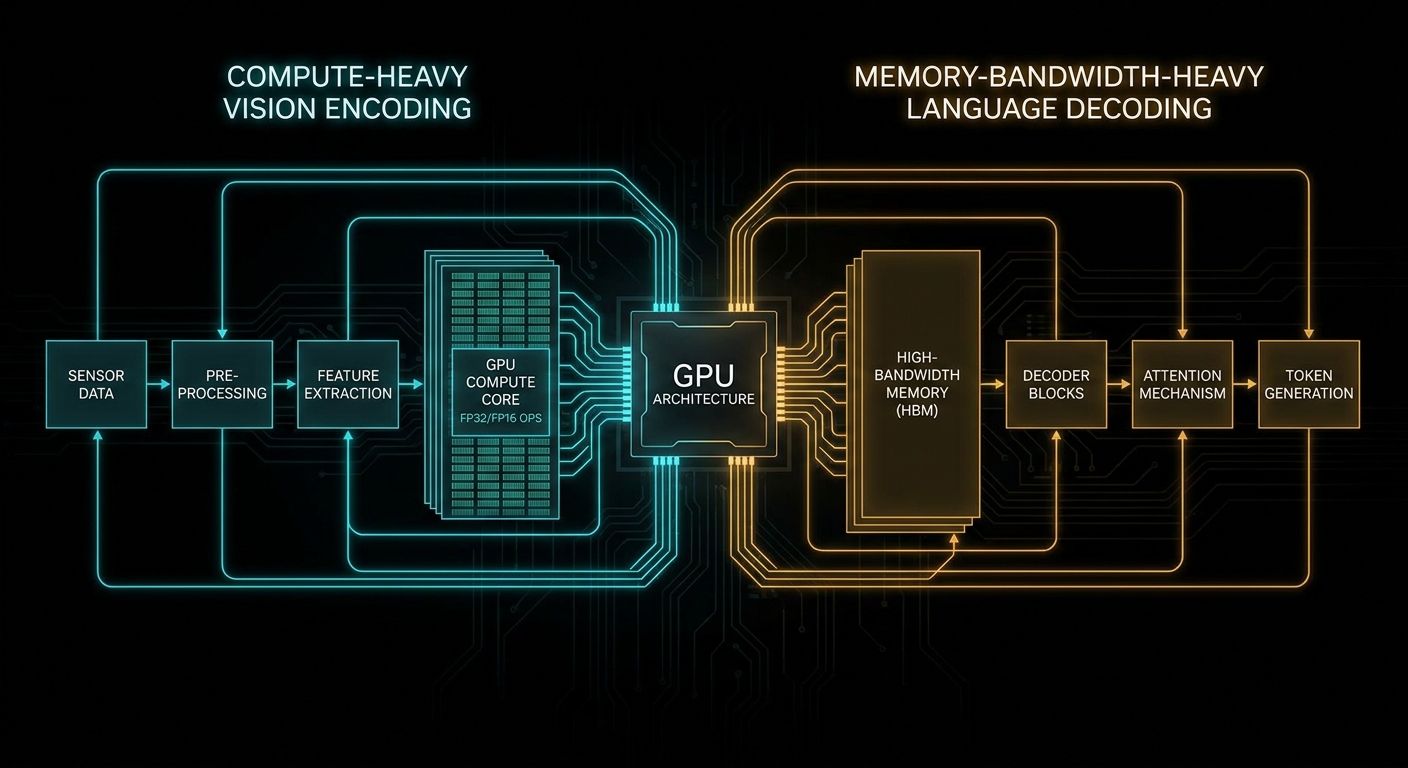
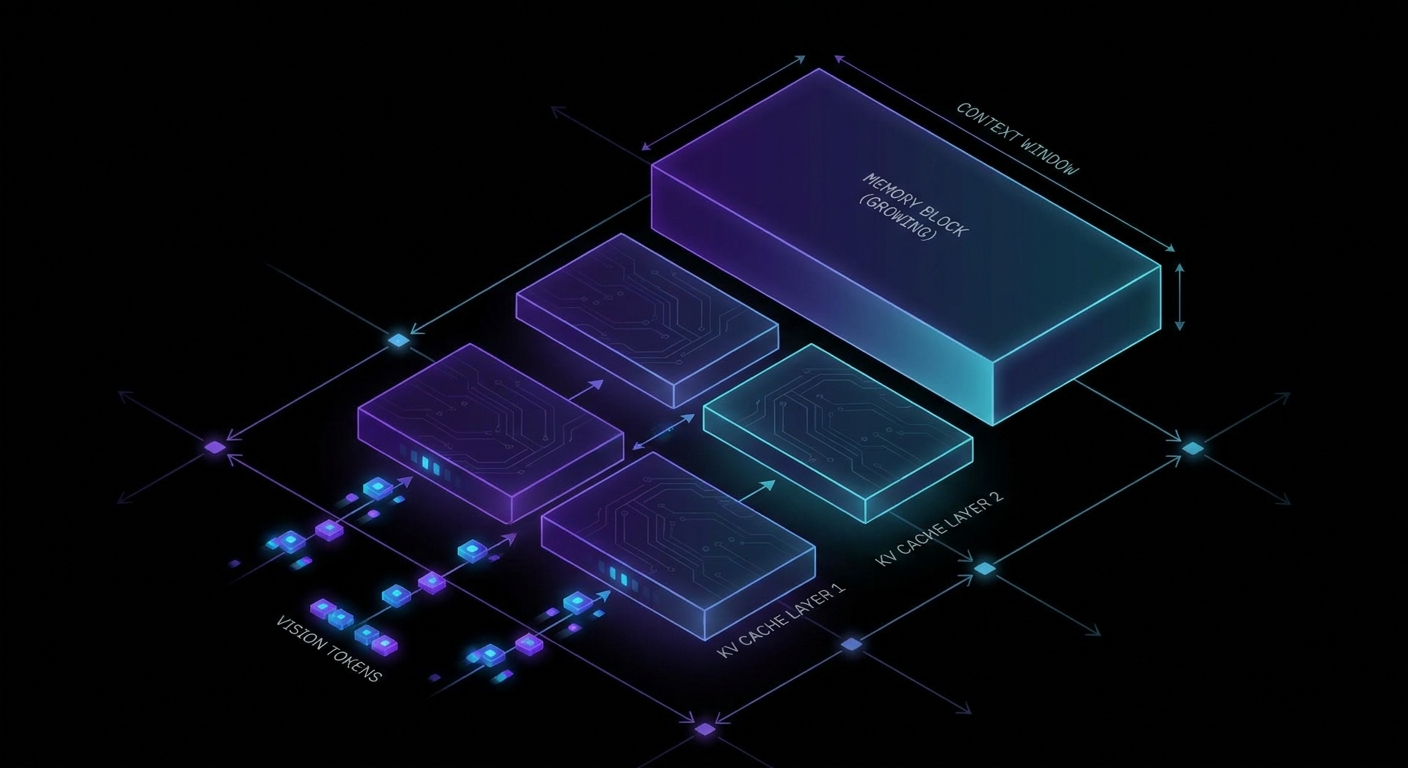
Two GPU workload phases with opposing compute and memory demands
Encode wants tensor cores. Decode wants memory bandwidth. One card rarely satisfies both demands at the same time.

Encode vs Decode: A Resource Inversion

A VLM pipeline is two engines operating in sequence. Understanding the difference between them is the whole article, so let us be precise.

Image encoding is a matrix-intensive operation. Patches from the image flow through a ViT-style vision tower; the bottleneck is floating-point compute. Profiling on consumer cards typically shows 80%+ tensor-core utilisation with single-digit HBM bandwidth use. The GPU is doing arithmetic; it is barely touching main memory.

Token decoding is the exact opposite. Each new token requires reloading the full weight matrix and the growing KV cache from HBM, performing a small amount of arithmetic, emitting one token, and repeating. On datacenter GPUs, bandwidth saturates while tensor cores sit nearly idle. The GPU is reading memory; it is barely doing arithmetic.

Co-locate both phases on one card and you permanently pay for capacity that each phase ignores. During encode, HBM is underused. During decode, tensor cores are underused. Neither phase gets hardware tuned for what it actually needs.

“Multimodal large language model (MLLM) inference splits into two phases with opposing hardware demands: vision encoding is compute-bound, while language generation is memory-bandwidth-bound.” — Donglin Yu et al., arXiv:2603.12707

Kleppmann’s Designing Data-Intensive Applications makes a related point about aggregate metrics: when the bottleneck shifts between pipeline stages, a single utilisation number averages two opposite stories into one misleadingly healthy reading. You need phase-level instrumentation, not a system-wide gauge.

Visual Tokens and the KV Cache Problem

To understand why high-resolution images hurt decode performance specifically, you need to understand what the KV cache holds and why it costs bandwidth.

During prefill, the model builds a KV cache: per-layer key and value tensors for every token in the input context. Without it, autoregressive decode would recompute full attention over the entire history on each step, which scales quadratically with sequence length. The cache trades memory for compute. That is a good trade – unless the cache is enormous.

Visual tokens join the cache at prefill and stay there for every single decode step. The model has already compressed the image into embeddings, but hundreds of image tokens still occupy HBM and get re-read with every token generated. The bandwidth cost is proportional to output length, not to how “done” the image processing feels.

Case 1: High-Resolution Inputs Bloat the Cache Before Decode Begins

A modest 336×336 image can produce approximately 576 visual tokens. Add 128 text tokens and you have 704 tokens in the KV cache before the first answer token is generated. For a 7B MHA model at FP16, that is roughly 350 MB per request. Scale to eight concurrent requests and you are using ~2.8 GB of cache capacity before generation has even started.

// FP16 KV cache size (one sequence):
// bytes ≈ 2 × layers × seq_len × kv_heads × head_dim × 2
//
// Text-only request (128 tokens):  ~64 MB
// Same request + one image (704 tokens): ~350 MB
//
// Quantisation reduces bytes per element.
// It does not remove the 576 persistent image token slots
// that get re-read on every decode step.

Case 2: Concurrency Makes the Problem Super-Linear

Raising batch size under multimodal load can actually hurt. More concurrent requests means more fat KV caches competing for the same HBM bandwidth simultaneously. Inter-token latency often climbs faster than image-token count alone would predict – the slope steepens because bandwidth contention compounds.

// Metrics to correlate (log all three together):
// - kv_cache_bytes per request vs image resolution
// - hbm_bandwidth_util during decode phase only
// - itl_p95 vs concurrent_request_count
//
// If ITL grows super-linearly with concurrency, you have
// bandwidth contention, not a "slow model".
KV cache growth with vision tokens
Image tokens enter the cache at prefill and remain for every decode step. Output length, not image size alone, sets the total bandwidth cost.

Where to Split the Pipeline

Once you accept that the two phases want different hardware, the next question is where to draw the boundary – and the answer matters more than it looks.

Prefill/decode split cuts the pipeline after prefill: a prefill node builds the KV cache and ships it to a decode node. The payload is the full KV tensor – hundreds of MB to GB depending on model depth and context length. That demands high-bandwidth interconnect (NVLink, InfiniBand). Ordinary PCIe clusters do not have enough throughput to make this worthwhile.

Encoder/decoder split cuts earlier: a vision encoder node processes the image and ships only the resulting embeddings to the LLM node. The payload is just token_count × hidden_size – the KV cache does not exist yet, so you never ship it across the wire.

// LLaVA-7B-style numbers (576 vision tokens, dim 4096, FP16):
//
// Vision embeddings across the wire: ~4.5 MB
// Full KV cache for same context: ~350 MB
// Ratio: ~78x less data at the encoder boundary
//
// PCIe transfer at 16 GB/s:
//   4.5 MB  -> sub-millisecond
//   350 MB  -> tens of milliseconds

“Partitioning here reduces transfer complexity from O(L·s_ctx) bytes (GB-scale KV caches under stage-level disaggregation) to O(N_v·d) bytes (MB-scale embeddings), an O(L) reduction where L is the transformer depth.” — Donglin Yu et al., arXiv:2603.12707

Yu et al. report 12×–196× transfer reductions across current architectures depending on model depth. The gap widens as models get deeper: embeddings stay compact at roughly the same size, while KV migration cost grows linearly with the number of transformer layers.

Matching Silicon to Phase

Once the split is in place, hardware assignment follows naturally. Encode nodes want FLOPs-per-dollar – consumer or commodity compute cards work well here. Decode nodes want HBM bandwidth and large VRAM – A100/H100 class. An RTX 4090 and an A100 have similar peak TFLOPS; the 4090 wins on FLOPs per dollar, but the A100 wins on memory bandwidth and total VRAM.

Heterogeneous deployments under this split have shown approximately 40% cost savings versus homogeneous baselines in recent benchmarks, with no measurable latency regression when scheduling is handled correctly. The standard inference engine tricks – CUDA graphs, packed prefill, paged KV – still apply and still matter, but they do not substitute for matching silicon to the workload phase.

Case 3: Text-Only Traffic Leaves Encoders Idle

A hard encode/decode split creates a utilisation problem during text-only bursts: the encoder pool sits idle while the decoder pool is saturated. Work-stealing schedulers solve this by letting encoder nodes absorb decode jobs when the vision queue is empty. The roles are not symmetric – decode workers cannot encode – but encode workers can handle text-only generation with their available compute, recovering utilisation without fragile dynamic role reassignment.

Diagnose Before You Re-Architect

Before splitting pools, confirm the bottleneck is actually the encode/decode phase mismatch and not something simpler:

  1. Isolate the variable. Hold model and sampling parameters fixed; vary only image resolution and count across requests.
  2. Plot ITL against vision-token count at a realistic concurrency level. A flat slope means bandwidth is not the issue.
  3. Profile each phase separately using Nsight Systems or equivalent. Look for compute-bound encode and bandwidth-bound decode as the diagnostic signature.
  4. Correlate with your serving metrics. vLLM exposes KV-cache utilisation and scheduler queue depth; use them.

When Monolithic Serving Is Enough

Dual pools make economic sense at sustained multimodal volume where a significant fraction of total inference spend is attributable to this mismatch – roughly a third or more of your bill. For prototypes, low-QPS applications, and teams that do not have the operational capacity to run and schedule heterogeneous fleets, staying on a single GPU is the right call until the numbers force a change. The same encode/decode asymmetry applies to audio and video input towers, not just vision – so if you later add speech input, the analysis carries over directly.

What to Check Right Now

  • KV bytes per request across the range of image resolutions your users actually send.
  • Phase-split profiling to confirm compute-bound encode and bandwidth-bound decode are both present.
  • ITL slope under concurrent load – super-linear growth signals bandwidth contention, not raw model speed.
  • Business case first. Heterogeneous pools add scheduling complexity. Run the cost arithmetic before committing to the architecture.

Half your GPU was on holiday during every request. The fix is giving each phase the silicon it actually uses – and knowing, precisely, which phase is slowing you down before you spend money on a bigger card.

nJoy 😉
Stop Sending Every Prompt to Your Flagship Model

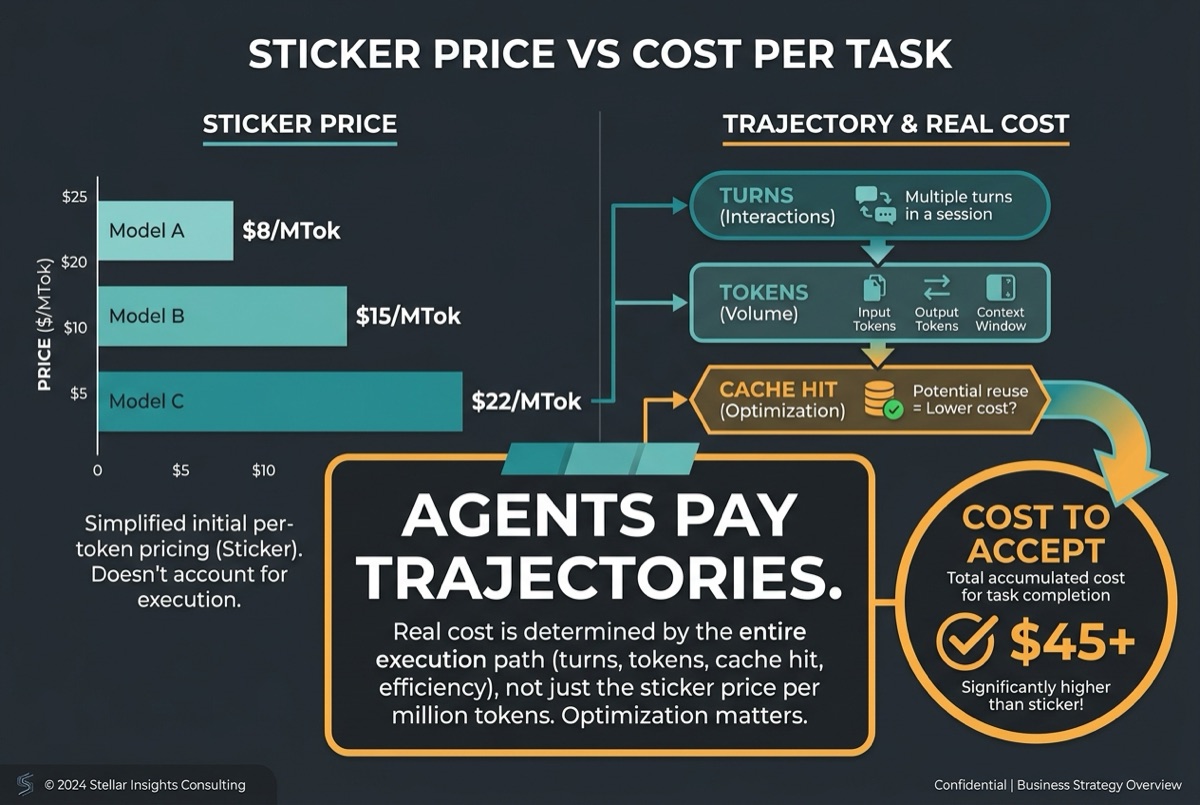
Every prompt that hits your API is not created equal, but your billing statement treats them as if they are. A twenty-token label extraction and a three-thousand-token reasoning trace cost the same per token at the same endpoint. That means every routing decision you do not make is implicitly a decision to use your most expensive capable model for everything – including the work that does not need it.

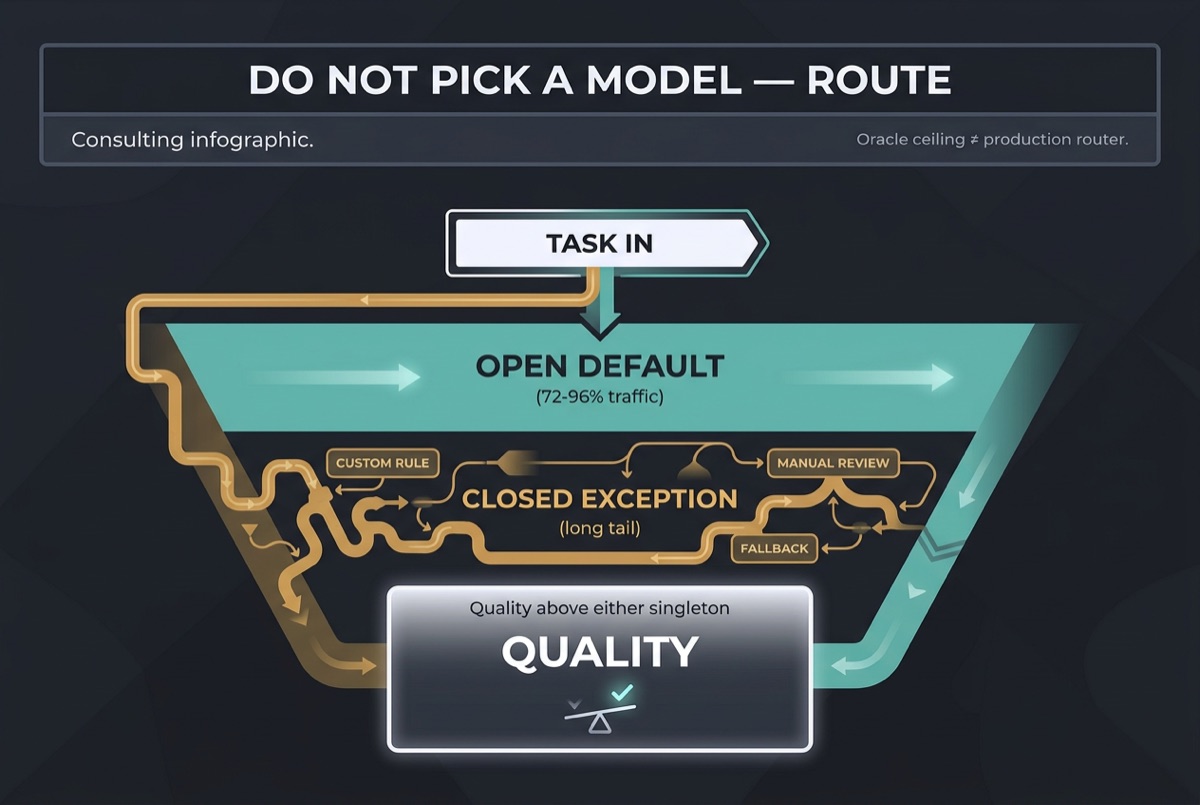
Task-tier routing is the fix: a thin layer between your application and the model pool that dispatches each request to a model whose capability (and cost) matches the job. Build it yourself in middleware, use a cascade, or adopt a managed semantic router. The architecture is the same across all three. Only the operational burden differs.

Requests routed to different model size tiers
Size the model to the task. The router makes that decision once per request type, not once per provider negotiation.

The One-Model Bill

Most production backends have at least three distinct call shapes running in parallel, even when they do not know it. Consider a realistic example:

  • Labelling – short text in, a single category token out. The model needs vocabulary and context, not deep reasoning.
  • Conversational answers – multi-turn prose, user-visible, tone-sensitive. Speed and coherence matter.
  • Analysis – long working, structured output, citations. Quality matters more than cost per call.

When all three routes share one endpoint, the label call pays frontier model prices. Here is what that actually costs:

// $/1M tokens (illustrative - your provider rates will differ, ratios hold):
//   Small instruct:     $0.10 input  / $0.30 output
//   Frontier chat:      $3.00 input  / $15.00 output
//   Reasoning-class:    $1.25 input  / $10.00 output
//
// Label call (~120 input tokens, 20 output tokens):
//   Small model:    ~$0.000018
//   Frontier model: ~$0.000660  (~37x more expensive)
//
// At 500,000 label calls per month:
//   Small model:    ~$9
//   Frontier model: ~$330  -- on one call type alone

That waste never appears as a line item. It hides inside one aggregate model spend figure, which is why most teams only discover it when they go looking.

“Through extensive experiments, we demonstrate that when compared to standalone expert models, TO-Router improves query efficiency by up to 40%, and leads to significant cost reductions of up to 30%, while maintaining or enhancing model performance by up to 10%.” — Stripelis et al., TensorOpera Router, EMNLP 2024

Three Ways to Decide Where a Prompt Goes

Each routing mechanism makes a different trade-off between latency overhead, implementation complexity, and accuracy.

Explicit routing. The caller tags its own request: a separate endpoint per task type, or a task field in the request body. Zero additional classifier latency, fully auditable, easy to debug. This is the right default when the caller already knows what kind of job it is sending – which is often the case in structured backends where each function in your code issues a specific type of prompt.

Content-based routing. A small classifier reads the prompt and matches it to a task description you maintain. Adds milliseconds to low seconds of overhead depending on model size, but keeps routing logic out of application code – useful when prompts arrive from users who do not specify intent. Crucially, task descriptions must describe the expected output shape, not the subject matter. “Return one label from: billing | bug | howto | account” will route correctly; “handle billing questions” will not.

Cascades. Send the prompt to the cheapest capable model first and escalate only when a confidence check fails. Yue et al. matched strong-model quality on reasoning benchmarks at approximately 40% of strong-model cost by escalating only when the weak model’s output showed low consistency across repeated samples.

“Through experiments on six reasoning benchmark datasets … we demonstrate that our proposed LLM cascades can achieve performance comparable to using solely the stronger LLM but require only 40% of its cost.” — Yue et al., arXiv:2310.03094

A Three-Tier Layout and Where It Breaks

A practical router uses three tiers: a small instruct model for extraction and labelling, a mid-tier chat model for interactive prose, and a reasoning-class model for deep analysis. The failure cases below are the ones that cause silent quality regressions or surprise cost spikes after initial deployment.

Case 1: Overlapping Task Descriptions Misroute Traffic

If two task descriptions could plausibly describe the same prompt, a semantic classifier will flip between tiers unpredictably or fall back to the default (usually the most expensive model). The problem is always in the description wording, not the classifier itself.

// Weak descriptions - both match "I have a billing question":
//   label: "Handle user messages about the product"
//   chat:  "Help customers with billing"
//
// Strong descriptions - output contract, not subject:
//   label: "Classify intent. Return exactly one token: billing|bug|howto|account"
//   chat:  "Write a helpful multi-sentence reply for the end user"
//
// The classifier routes on output shape, not topic.
// If you cannot write distinct output contracts, merge the tiers.

Case 2: Reasoning Paths Run Out of Completion Budget

Models that use extended thinking or chain-of-thought consume output tokens for reasoning before the visible answer. A 1024-token completion cap can yield empty visible content and a finish_reason: length response, with no error raised. On analysis-tier routes, treat 4096 tokens as a floor for the completion budget, not a ceiling.

Case 3: Switching Models Mid-Session Breaks Prefix Cache and Tone

When a multi-turn session starts on the mid-tier model and escalates to reasoning-class on turn three, two things break: the provider cannot reuse the cached prefix from the earlier turns (repaying full input cost), and the model’s response style may shift noticeably within one conversation. The fix is to pin a session to the model chosen on its first turn.

// Session-pinned routing in Node.js:
async function chat(sessionId, messages) {
  // Look up the model assigned when this session started.
  let tier = await sessionCache.get(sessionId);

  if (!tier) {
    // First turn: classify and persist.
    tier = await classifyTaskTier(messages);
    await sessionCache.set(sessionId, tier, { ttl: 3600 });
  }

  return invokeModel(tier, messages);
}
// Result: consistent prefix cache, consistent voice.
Classifier matching prompts to model pools
The classifier reads intent and routes to the appropriate pool. The fallback path should route to a cheap general model, never silently upgrade.

Selection Policies Inside Each Tier

Choosing a tier is half the decision. Within each tier you still need a policy for picking among multiple available models:

  • Cheapest acceptable for labelling and extraction – quality differences between small models are negligible for binary classification.
  • Lowest TTFT for interactive UI – a 200 ms response gap is noticeable to users; a 5% quality difference is not.
  • Fixed priority list when you have a ranked preference (try provider A, fall back to B, then C on error).
  • Cascade with confidence gate when most queries are easy but a long tail requires the flagship model – escalate only on low-confidence outputs from the cheaper tier.

Always define a fallback. Unmatched prompts should land on a cheap general model, not throw an error or silently route to the most expensive endpoint you have.

Telemetry You Actually Need

Without per-request logging, you cannot separate routing savings from a natural shift in traffic mix. Log these fields for every request: matched tier, serving model, tokens in, tokens out, estimated cost, TTFT, and total latency. After a week, plot cost-per-task-type before and after routing. That is the only number that proves the router is doing its job.

When to Skip Routing Altogether

Routing adds a moving part that requires calibration and monitoring. Skip it when:

  • Every call genuinely needs the same capability – there is no cheaper model that passes your quality bar.
  • Monthly spend is too small to justify the operational overhead of maintaining task descriptions.
  • Your compliance requirements demand deterministic, explainable model selection for every request (use explicit endpoint tagging instead).
  • You have not yet measured your actual task mix – routing based on assumptions rather than data will create more problems than it solves.

Rollout Without Surprises

  1. Sample first. Pull a week of production prompts and label them by task type manually. You need ground truth before building a classifier.
  2. Price the counterfactual. For each task type, calculate what it would cost at the cheaper tier. This is your upper-bound savings estimate.
  3. Eval the cheaper models on each task type before any traffic moves. Do not assume quality is adequate; measure it.
  4. Shadow-route. Run the router in logging-only mode: record decisions and estimated costs, but still serve the original model. Catch misroutes before they affect users.
  5. Canary 5% of live traffic. Watch real cost and quality metrics for a week before full cutover.

What to Check Right Now

  • Task mix histogram from last week’s logs – if you do not have one, that is the first step.
  • Retrospective cost estimate – what would tiered routing have cost versus what you actually spent?
  • Task description overlap if you are already using or planning semantic routing.
  • Completion token floors on any analysis or reasoning path – check that max_tokens is not silently truncating outputs.

The waste is invisible until you look for it. Once you see the histogram of task types against the tier each one actually needed, it is very hard to unsee.

nJoy 😉
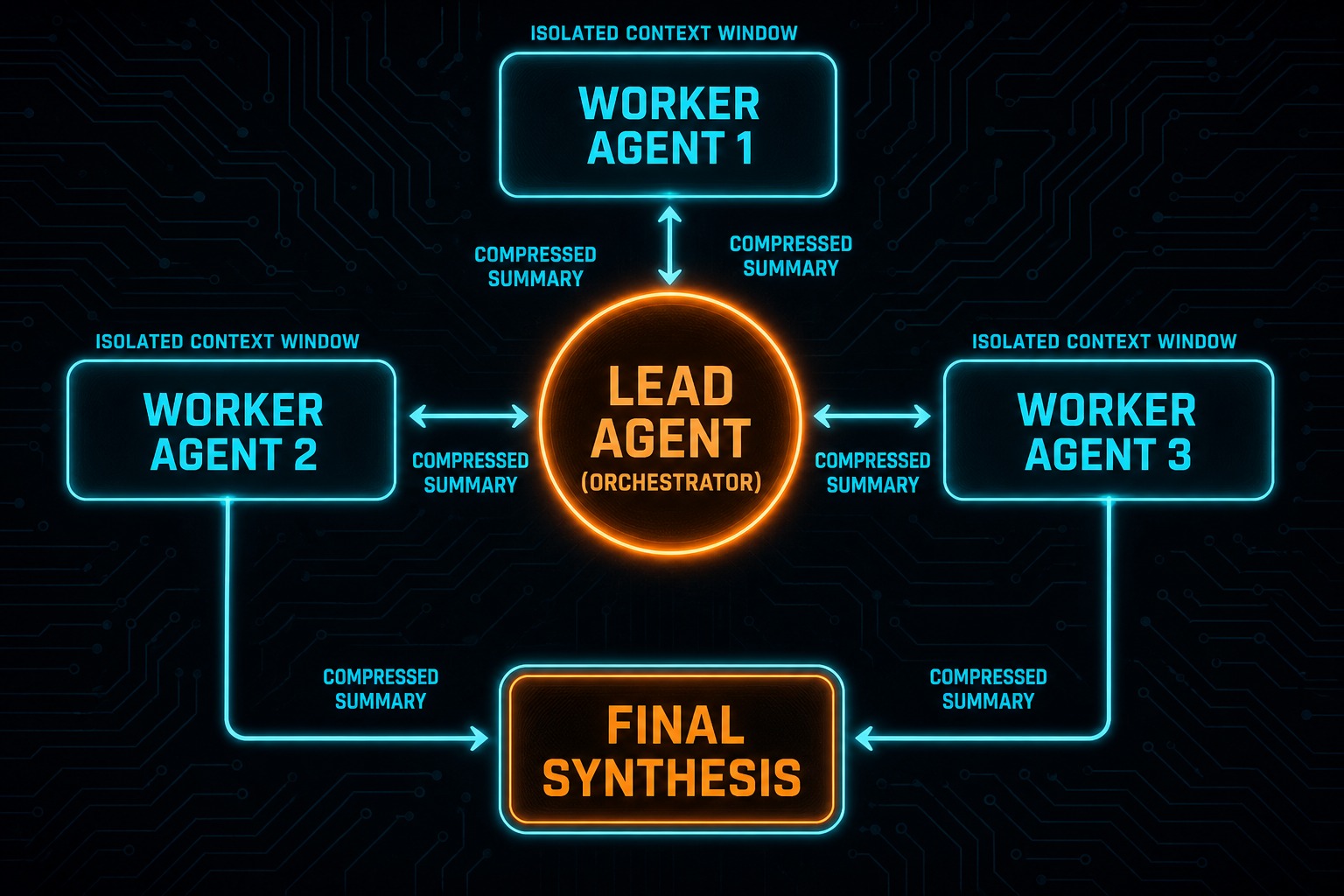
Gemma 4 on Apple Silicon: All Four Models Compared, Benchmarked, and Running Locally

Google just dropped a 31-billion-parameter model that sits on the same leaderboard row as Claude Sonnet 4.5 and outranks models 20 times its size. That is not a typo. Gemma 4 31B, released under Apache 2.0 on 2 April 2026, is the densest punch-per-parameter open model the industry has ever seen, and you can run it on the MacBook you already own. If you have been paying $20-200 a month for API access to frontier models, this article is about to ruin your budget justification.

Gemma 4 31B dense model architecture visualisation, dark technical diagram
Gemma 4 31B – Google DeepMind’s flagship open model, now runnable on consumer hardware.

What Exactly Is Gemma 4 31B?

Gemma 4 is a family of open-weight models from Google DeepMind, built from the same research and technology that powers Gemini 3. The family ships in four sizes: E2B and E4B for phones and edge devices, a 26B Mixture-of-Experts (MoE) variant, and the 31B dense flagship. This article focuses on the 31B dense model, which is the largest, highest-quality member of the family.

The 31B is a dense transformer, meaning all 30.7 billion parameters fire on every single token. There is no routing, no gating, no “some experts sleep whilst others work.” Every weight participates in every inference step. That architectural simplicity buys you two things: predictable behaviour and maximum quality per parameter.

Here are the core specifications, straight from the official model card:

Property Gemma 4 31B Dense
Total Parameters 30.7B
Active Parameters 30.7B (all of them, every token)
Layers 60
Context Window 256K tokens
Sliding Window 1,024 tokens
Vocabulary Size 262K
Vision Encoder ~550M parameters (27-layer ViT with 2D RoPE)
Audio Not supported (E2B/E4B only)
Licence Apache 2.0
Input Modalities Text + Images (variable resolution)

The architecture uses a hybrid attention mechanism that interleaves local sliding-window attention with full global attention, ensuring the final layer is always global. Global layers use unified Keys and Values with Proportional RoPE (p-RoPE) to keep memory manageable at long context lengths. In plain English: the model can see its full 256K-token window without the memory cost exploding the way it would with naive full attention on every layer.

“Built from the same world-class research and technology as Gemini 3, Gemma 4 is the most capable model family you can run on your hardware.” – Google, Gemma 4 Launch Blog

Dense vs Sparse vs MoE: The Architecture That Matters

Understanding why Gemma 4 ships two different 20-30B models requires understanding three architectural paradigms that define how modern LLMs spend compute. This is the single most important concept for choosing which model to run locally, so let us get it right.

Dense Models: Every Neuron, Every Token

A dense transformer activates 100% of its parameters on every forward pass. If a model has 31 billion parameters, it performs 31 billion parameters’ worth of computation for every single token it generates. This is the classical architecture from “Attention Is All You Need” (Vaswani et al., 2017), and it remains the gold standard for raw quality. Dense models are simpler to train, more predictable in behaviour, and generally produce the highest-quality outputs at a given parameter count.

The downside is obvious: compute cost scales linearly with parameter count. Double the parameters, double the FLOPs per token. Gemma 4 31B is a dense model, and that is precisely why it tops the quality charts.

Mixture-of-Experts (MoE): Conditional Computation

MoE models replace certain feed-forward layers with multiple parallel “expert” sub-networks. A learned routing network examines each token and decides which experts handle it. Only a small subset of experts activate per token, so the total parameter count far exceeds the active parameter count.

Take Gemma 4’s 26B A4B variant as a concrete example:

Property 26B A4B MoE 31B Dense
Total Parameters 25.2B 30.7B
Active Parameters per Token 3.8B 30.7B
Expert Count 128 total, 8 active + 1 shared N/A (dense)
Layers 30 60
Arena AI Score 1,441 1,452
Inference Speed ~4B model speed ~31B model speed

The 26B MoE only activates 3.8 billion parameters per token. That means it computes at roughly the speed of a 4B dense model, despite having the “knowledge capacity” of a 25B model. The trade-off? Slightly lower peak quality and less predictable behaviour for fine-tuning, because the routing decisions add a stochastic element the dense model does not have.

Gemma 4’s MoE is architecturally unusual: each layer runs both a dense GeGLU FFN and a 128-expert MoE system in parallel, then sums the outputs. Most MoE architectures replace the FFN entirely. Gemma 4 keeps both, which partly explains why its MoE variant scores so close to the dense model despite activating far fewer parameters.

Sparse Models: The General Category

MoE is a specific type of sparse architecture, but “sparse” is the broader umbrella. Any model that selectively activates a subset of its parameters per token is sparse. The key insight, as described in Christopher Bishop’s Pattern Recognition and Machine Learning, is that not every feature in a learned representation is relevant to every input. Sparsity exploits this by routing computation only where it is needed.

Here is the practical cheat-sheet:

Architecture Compute per Token Memory Footprint Best For
Dense All parameters All parameters must fit Maximum quality, fine-tuning, predictable outputs
MoE (Sparse) Active subset only All parameters must still fit Fast inference, responsive chat, latency-critical agents
Quantised Dense All parameters (reduced precision) Reduced (e.g. 4-bit = ~4x smaller) Running dense models on constrained hardware

A critical nuance: MoE does not reduce memory requirements. All 25.2B parameters of the 26B MoE must be loaded into memory even though only 3.8B are active per token. The inactive experts are idle but still resident. MoE saves compute, not memory. This is why quantisation and MoE are complementary techniques, and why running the Q4-quantised 31B dense on a Mac with 24GB is actually a better deal than running the full-precision 26B MoE.

Dense vs MoE architecture comparison diagram, dark technical illustration
Dense models fire every neuron; MoE routes each token through a small subset of specialised experts.

The Benchmarks: Arena Rankings and Hard Numbers

Benchmarks are a minefield of cherry-picked numbers and suspiciously round percentages. So let us look at two sources: the Arena AI human-preference leaderboard and the automated benchmark suite from Google’s own model card.

Arena AI: Human Preference Rankings

As of 31 March 2026, the Arena AI text leaderboard has 337 models ranked from 5.7 million human votes. Here is where Gemma 4 lands in the overall table:

Model Organisation Licence Arena Score
Claude Opus 4.6 Thinking Anthropic Proprietary 1,504 +/- 6
Claude Opus 4.6 Anthropic Proprietary 1,499 +/- 5
Gemini 3.1 Pro Google Proprietary 1,494 +/- 5
Claude Sonnet 4.5 Thinking Anthropic Proprietary 1,452 +/- 3
Gemma 4 31B Google Apache 2.0 1,452 +/- 9
Qwen 3.5 397B A17B Alibaba Apache 2.0 1,449 +/- 6
Gemini 2.5 Pro Google Proprietary 1,448 +/- 3
Gemma 4 26B A4B Google Apache 2.0 1,441 +/- 9

Read that again. Gemma 4 31B scores 1,452, matching Claude Sonnet 4.5 Thinking and outranking Gemini 2.5 Pro and Qwen 3.5 397B. Among open-source models, it is ranked #3 in the world. This 31-billion-parameter model is competing with, and beating, models that are far larger. Google claims it “outperforms models up to 20 times larger,” and the Arena data backs that up.

Automated Benchmarks: The Full Picture

Here is a compact benchmark comparison from Google’s official model card:

Benchmark Gemma 4 31B Gemma 4 26B MoE Gemma 3 27B
MMLU Pro 85.2% 82.6% 67.6%
AIME 2026 89.2% 88.3% 20.8%
LiveCodeBench v6 80.0% 77.1% 29.1%
GPQA Diamond 84.3% 82.3% 42.4%
Codeforces ELO 2,150 1,718 110
MMMU Pro 76.9% 73.8% 49.7%
MMMLU 88.4% 86.3% 70.7%

The AIME 2026 jump is staggering: from 20.8% to 89.2%. The Codeforces ELO went from 110 to 2,150. This is not a small step over Gemma 3, it is a generational leap.

Running Gemma 4 31B on a Mac: The Practical Guide

This is where it gets exciting for anyone with an Apple Silicon Mac. The unified memory architecture on M-series chips is a genuine superpower for local LLM inference, because the GPU and CPU share the same RAM pool. No separate VRAM cliff. If you have 24GB, 36GB, or more of unified memory, you are in business.

Memory Requirements

Precision Approx. Size Minimum Memory Mac Recommendation
BF16 ~58 GB 64 GB+ M2/M3/M4 Max 64GB+
FP8 ~30 GB 36 GB+ M3/M4 Pro 36GB
Q4_K_M ~20 GB 24 GB+ M2/M3/M4 Pro 24GB
Q3 ~15 GB 18 GB+ Smaller Macs

The sweet spot for most Mac users is Q4_K_M quantisation at about 20GB. This is the default distribution on Ollama, and it fits comfortably on a 24GB Mac with some headroom left for the operating system.

Step 1: Install Ollama

curl -fsSL https://ollama.com/install.sh | sh

Or download the macOS app directly from ollama.com.

Step 2: Pull and Run the Model

ollama run gemma4:31b

That is it. Two commands total. The download is around 20GB, and then you are chatting with a model that matches Claude Sonnet 4.5 on the Arena leaderboard.

Expected Performance on Apple Silicon

Mac Configuration Quantisation Approx. Speed Notes
M4 Max 128GB Q4_K_M 40-50 tok/s Very fast local inference
M3/M4 Pro 36GB Q4_K_M 20-35 tok/s Comfortable for extended use
M2/M3 Pro 24GB Q4_K_M 15-25 tok/s Usable, context size matters
M1/M2 16GB Q3 8-15 tok/s Tight, consider 26B MoE or E4B

For reference, human reading speed is roughly 4-5 tokens per second. Even the slower configurations are still readable in real time.

MLX: The Apple Silicon Optimiser

If you want to squeeze more performance out of your Mac, look into MLX, Apple’s machine learning framework optimised specifically for Apple Silicon. Community support for Gemma 4 landed almost immediately, and MLX-optimised models can outperform GGUF-based inference on the same hardware.

pip install mlx-lm
mlx_lm.generate --model Phipper/gemma-4-31b-it-mlx-4bit --prompt "Hello, world"

The trade-off: MLX requires more manual setup than Ollama. For most users, Ollama is the right starting point. For performance enthusiasts, MLX is where things get fun.

Mac running local AI model, dark technical setup
Apple Silicon’s unified memory architecture makes Macs surprisingly capable local LLM machines.

The Complete Gemma 4 Family: Four Models, Four Use Cases

The 31B dense flagship is the headline act, but Google shipped three other models in the same family, and understanding the full lineup matters because the right model for you depends on what you have in your pocket, on your desk, or in your rack. Here is the entire family at a glance:

Model Architecture Effective Params Context Modalities Q4 Memory
E2B Dense (edge) 2.3B 128K Text, Image, Audio ~3.2 GB
E4B Dense (edge) 4.5B 128K Text, Image, Audio ~5 GB
26B A4B MoE (128 experts) 3.8B active 256K Text, Image ~15.6 GB
31B Dense 30.7B 256K Text, Image ~17.4 GB

Two things jump out immediately. First, the smaller models are the ones with audio support, not the flagship. The E2B and E4B each carry a dedicated ~300M-parameter audio encoder that the larger models lack. Second, the edge models use a technique called Per-Layer Embeddings (PLE), which gives each decoder layer its own small embedding table for every token. These tables are large but only used for lookups, which is why the “effective” parameter count is much smaller than the total on disk.

Gemma 4 E2B: The Phone Model

E2B has 5.1 billion total parameters but only 2.3 billion effective, and it fits in roughly 3.2 GB at Q4 quantisation. This is small enough to run on a three-year-old smartphone. Through the Google AI Edge Gallery app (available on both iOS and Android), you can download E2B at about 2.5 GB on disk and start chatting with it entirely offline.

The performance claim that shocked the community: E2B beats Gemma 3 27B on most benchmarks despite being roughly 12x smaller in effective parameters. One early tester running it on a basic i7 laptop with 32 GB RAM reported it was “not only faster, it gives significantly better answers” than Qwen 3.5 4B for finance analysis. On a phone, users are seeing roughly 30 tokens per second, which is genuinely conversational speed.

For a Mac with only 8 GB of unified memory, E2B at Q4 is the safe bet. It leaves plenty of headroom for macOS and whatever else you are running. Install it with:

ollama run gemma4:e2b

Gemma 4 E4B: The Best Small Model You Can Run Anywhere

E4B is the sweet spot for anyone who wants something meaningfully smarter than E2B without jumping to the heavyweight models. At 8 billion total parameters (4.5B effective) and ~5 GB at Q4, it fits comfortably on any Mac with 16 GB of memory and leaves room for a browser, an IDE, and Slack running simultaneously.

E4B is the model David Ondrej demonstrated running on his iPhone 16 Pro Max in the video, and it was clearly usable at conversational speeds. The Edge Gallery app lists it at 3.6 GB on disk. On a phone with a modern chip, expect 20-30 tokens per second. On a Mac with 16 GB, expect 40-60+ tokens per second since the model is small enough to stay entirely in the GPU memory partition.

Crucially, E4B supports native audio input alongside text, image, and video. That means on-device speech recognition, spoken language understanding, and audio analysis, all without sending a byte off your machine. The 31B flagship cannot do any of this.

ollama run gemma4:e4b

Gemma 4 26B A4B: The Speed Demon

The 26B MoE is the model for people who want high-end quality at dramatically lower latency. Despite having 25.2 billion total parameters, only 3.8 billion are active per token, which means it runs at roughly the speed of a 4B dense model whilst retaining the knowledge capacity of a 25B model.

Real-world benchmarks from Kartikey Chauhan’s testing on a 12 GB VRAM Nvidia card show 44.2 tokens per second for text at 128K context and 42.1 tok/s for vision at 64K context. Those are server-grade numbers from consumer hardware.

On a Mac with 16 GB of unified memory, the 26B A4B at Q4 (~15.6 GB) is technically possible but tight. You will be at the limit of available memory, and macOS itself needs headroom. A 24 GB Mac runs it comfortably. For 16 GB Macs, be conservative with context length and expect some performance degradation from memory pressure.

ollama run gemma4:26b

Quality vs Size: What You Actually Lose at Each Step Down

The perennial question with model families is: how much quality do you sacrifice for each size reduction? With Gemma 4, Google published enough benchmark data to answer this precisely. Here is the full family compared side by side:

Benchmark 31B Dense 26B MoE E4B E2B Gemma 3 27B
MMLU Pro 85.2% 82.6% 69.4% 60.0% 67.6%
AIME 2026 (Maths) 89.2% 88.3% 42.5% 37.5% 20.8%
LiveCodeBench v6 80.0% 77.1% 52.0% 44.0% 29.1%
GPQA Diamond 84.3% 82.3% 58.6% 43.4% 42.4%
MMMU Pro (Vision) 76.9% 73.8% 52.6% 44.2% 49.7%
MMMLU (Multilingual) 88.4% 86.3% 76.6% 67.4% 70.7%
Tau2 Agentic (avg over 3) 76.9% 68.2% 42.2% 24.5% 16.2%
Codeforces ELO 2,150 1,718 940 633 110

The pattern is clear: the 31B-to-26B step is almost free. You lose roughly 2-3 percentage points on most benchmarks but gain dramatically faster inference. This is the best trade-off in the entire lineup. The 26B MoE at 88.3% on AIME is essentially indistinguishable from the 31B’s 89.2% for any practical purpose.

The 26B-to-E4B step is where the cliff hits. You go from 88.3% to 42.5% on AIME, from 77.1% to 52.0% on LiveCodeBench, and from 85.5% to 57.5% on agentic tasks. This is where “frontier local model” becomes “capable assistant.” E4B is excellent for its size, but it is not in the same league as the two larger models for maths, competitive coding, or complex tool use.

The E4B-to-E2B step is gentler than expected. E2B typically loses 5-15 percentage points versus E4B, which is surprisingly modest given the 2x parameter difference. For basic Q&A, translation, summarisation, and conversational use, E2B is genuinely useful. It even beats Gemma 3 27B on multilingual tasks (67.4% vs 70.7% is close, but E2B’s AIME score of 37.5% vs Gemma 3’s 20.8% is a clear win).

Perhaps the most striking trend in the table: E2B scores 24.5% on Tau2 agentic tasks versus Gemma 3 27B’s 16.2%. A model you can run on a phone outperforms last year’s full-size model at tool use by a clear margin. Meanwhile, the 31B’s 76.9% average across all three Tau2 domains is nearly 5x what Gemma 3 managed. That is not an incremental improvement; it is proof that architectural progress matters more than raw scale.

Running Every Gemma 4 Model: A Hardware Decision Tree

Here is the practical guide to matching your hardware to the right model. Start from whatever you own and work your way to the best model it can handle:

Your Hardware Best Gemma 4 Model Quantisation Expected Speed Quality Tier
iPhone / Android (3+ years old) E2B INT4 ~30 tok/s Good assistant, basic coding
iPhone / Android (recent) E4B INT4 20-30 tok/s Strong assistant, decent coding
Mac M1/M2 8GB E2B or E4B Q4 50-80 tok/s Good assistant with audio
Mac M1/M2/M3 16GB E4B (safe) or 26B A4B (tight) Q4 40-60 / 15-25 tok/s Strong / Near-frontier
Mac M2/M3/M4 Pro 24GB 26B A4B or 31B Q4 25-40 / 15-25 tok/s Near-frontier / Frontier
Mac M3/M4 Pro 36GB 31B Q4 or Q8 20-35 tok/s Frontier
Mac M3/M4 Max 64GB+ 31B BF16 40-50 tok/s Frontier, full precision
Nvidia GPU 12GB VRAM 26B A4B Q5 ~44 tok/s Near-frontier

The 12 GB Nvidia GPU result deserves special mention. Kartikey Chauhan’s detailed benchmarking of the 26B A4B on a 12 GB card using llama.cpp showed 44.2 tokens per second for text and 42.1 tok/s for vision, both at 128K context. He reported that the model is “an excellent default” for daily interactive use, with stable generation and no constant OOM babysitting once the right memory profile is set. The key was using fit-based GPU placement rather than forcing everything into VRAM.

For the edge models on phones, the Google AI Edge Gallery app is genuinely the easiest path. Download it, pick E2B or E4B, wait for the 2.5-3.6 GB download, and start chatting. Everything runs offline, nothing leaves your device, and the models support function calling for agentic tasks directly on the phone.

The 16 GB Mac Dilemma

The most common question in the community: “I have a MacBook with 16 GB, can I run the good stuff?” The honest answer is nuanced:

  • E4B at Q4 (~5 GB): Runs beautifully. Fast, responsive, with plenty of headroom. This is the comfortable choice.
  • 26B A4B at Q4 (~15.6 GB): Technically fits but leaves almost no room for macOS and apps. Expect memory pressure, swap usage, and slower generation as context grows. Usable for short conversations; painful for long ones.
  • 31B at Q4 (~17.4 GB): Does not fit. You will hit swap immediately, and inference will crawl.

If you have a 16 GB Mac and want the best possible quality, the 26B A4B is your ceiling, but keep context short and close other apps. If you want a smooth, reliable experience, E4B is the pragmatic winner. It scores 52% on LiveCodeBench (enough for practical coding help), 58.6% on GPQA Diamond (solid science reasoning), and it can process audio natively, which neither of the larger models can.

How Good Are These Models for Coding?

If you are a developer considering local models as a coding assistant, the benchmark numbers matter less than a straight answer: can this thing actually help me write code? Here is the honest breakdown for each model, using LiveCodeBench v6 (real coding tasks, not just function completion) and Codeforces ELO (competitive problem solving) as the primary yardsticks:

Model LiveCodeBench v6 Codeforces ELO Comparable To Practical Coding Level
E2B 44.0% 633 GPT-3.5-class Handles boilerplate, simple functions, basic refactors. Struggles with multi-file logic or complex algorithms.
E4B 52.0% 940 GPT-4o-mini / Claude 3.5 Haiku Writes working functions, understands context, handles standard patterns. The level that powers most “free tier” coding assistants.
26B A4B 77.1% 1,718 GPT-4o / Claude 3.5 Sonnet Strong coder. Handles multi-step problems, debugging, architectural reasoning, and non-trivial algorithms reliably.
31B 80.0% 2,150 Claude Sonnet 4.5 Frontier-class. Solves most competitive programming problems and writes production-quality code with real architectural awareness.

The Codeforces 1,718 ELO for the 26B MoE puts it at roughly “Candidate Master” level, meaning it can solve the majority of interview-style programming problems and a solid chunk of competitive challenges. The 31B at 2,150 ELO is in “Master” territory. For context, Gemma 3 27B scored 110 ELO on the same benchmark. That is not a typo.

The practical takeaway: if you have the memory for the 26B A4B or 31B, you have a genuinely capable local coding assistant that rivals the paid API models most developers use today. If you are limited to E4B, you still get a useful companion for everyday development, roughly on par with the models that power free-tier tools like GitHub Copilot’s lighter backend. E2B is better suited for quick scripting help, code explanation, and boilerplate generation than for serious algorithmic work.

A Suggested Workflow for Constrained Hardware

If your Mac cannot comfortably run the 26B or 31B, a practical approach is to run E4B as your always-on local model for inline help, autocomplete, and quick questions, then fall back to a cloud API (Claude, GPT-4o, or Gemma 4 31B via Google AI Studio, which offers a free tier) for the 20% of problems where E4B is not enough. You get speed and privacy for the easy stuff, and quality for the hard stuff.

CPU-Only Servers: Running Gemma 4 Without a GPU

Not everyone runs inference on a laptop or a gaming PC. If you have access to a rack server, a cloud VM, or any x86 machine with a lot of RAM but no GPU, Gemma 4 still works. The entire family runs on CPU-only hardware via llama.cpp, Ollama, or vLLM.

The key constraint on CPU-only inference is memory bandwidth, not compute. LLM token generation is fundamentally a memory-bound operation: the model reads weights from RAM for every token. A typical DDR4 server delivers 40-80 GB/s of memory bandwidth, versus 200-400 GB/s on Apple Silicon or 900+ GB/s on an Nvidia A100. Those extra CPU cores help with prompt ingestion (prefill) but barely move the needle on generation speed.

Here is what to expect on a typical high-core-count x86 server with DDR4 (e.g., a dual-socket Xeon or EPYC with 256-384 GB RAM):

Model Precision RAM Used Est. Generation Speed Best Use Case
E2B BF16 ~10 GB 15-30 tok/s High-throughput batch processing, multi-worker serving
E4B BF16 ~16 GB 10-20 tok/s Quality-per-watt sweet spot for CPU serving
26B A4B BF16 ~50 GB 8-15 tok/s Near-frontier quality, MoE helps since less data moves per token
31B BF16 ~58 GB 3-8 tok/s Maximum quality when latency is not critical

With 384 GB of RAM, you can run the 31B at full BF16 precision with no quantisation loss at all. Most consumer setups cannot do this. The trade-off is generation speed: expect 3-8 tokens per second for the 31B on DDR4, which is below human reading speed (~4-5 tok/s) but still usable for batch jobs, API backends, or any workflow where you do not need instant responses.

The 26B MoE is the star on CPU-only servers. Because only 3.8B parameters are active per token, it moves far less data through the memory bus than the 31B dense model, which means the memory-bandwidth bottleneck hurts less. Expect 8-15 tok/s at full precision, which is genuinely conversational speed, with quality only 2-3% behind the flagship.

For serving multiple concurrent users, consider running several E4B instances across those 56 cores rather than one large model. Each instance uses ~16 GB at BF16, so you could run 10+ parallel workers within 384 GB of RAM, giving you high aggregate throughput for an internal team.

Multimodal Capabilities: What It Can and Cannot See

Gemma 4 31B is multimodal for vision, accepting both text and images as input with text output. It includes a ~550M-parameter vision encoder and supports variable aspect ratios and resolutions.

  • Object detection and description – identify and describe objects in images
  • Document and PDF parsing – extract structure and text
  • OCR – including multilingual OCR
  • Chart comprehension – read graphs and visual data
  • Screen and UI understanding – parse app screenshots and interfaces
  • Video understanding – analyse sequences of frames

On MMMU Pro, Gemma 4 31B scores 76.9%, up from Gemma 3’s 49.7%. That is a serious jump in multimodal quality.

What it cannot do: the 31B model does not support audio input. Audio is only available on E2B and E4B. So if you need speech recognition or spoken language understanding, the small models are actually more capable in that modality than the flagship.

140+ Language Support

Gemma 4 is trained on over 140 languages, with out-of-the-box support for 35+ languages. Community testing suggests it is especially strong on multilingual tasks, and the official MMMLU score of 88.4% backs that up.

“Natively trained on over 140 languages, Gemma 4 helps developers build inclusive, high-performance applications for a global audience.” – Google AI for Developers, Gemma 4 Model Overview

This multilingual strength is one of Gemma 4’s real differentiators. If you build products for non-English audiences, this is not a side feature, it is the feature.

Choosing the Right Model: A Practical Decision Guide

With four models in the family, the question is no longer “should I run Gemma 4?” but “which Gemma 4?” Here is the decision matrix:

  • You have 24 GB+ and want the absolute best quality: Run the 31B dense. It is the quality ceiling of the family.
  • You have 24 GB+ but care about speed: Run the 26B A4B MoE. You lose 2-3% on benchmarks but gain roughly 2-4x faster inference. For most real tasks, you will not notice the quality difference.
  • You have a 16 GB Mac: The E4B is your best realistic option. The 26B A4B technically fits at Q4 but will struggle with memory pressure. E4B leaves comfortable headroom and still scores above Gemma 3 27B on key benchmarks.
  • You have an 8 GB Mac or a phone: Run E2B. At ~3.2 GB it fits anywhere, and it still beats Gemma 3 27B on maths and coding benchmarks despite being 12x smaller.
  • You need audio processing: Only E2B and E4B support native audio input. The 31B and 26B cannot hear anything.
  • You want to run AI entirely offline on your phone: Install the Google AI Edge Gallery app and pick E2B (2.5 GB) or E4B (3.6 GB). Everything runs locally, no data leaves your device.
  • You need the longest possible context: Only the 31B and 26B support 256K tokens. The edge models cap at 128K.
  • You want the absolute fastest time-to-first-token: E2B is the speed king, though E4B is close behind.

What to Check Right Now

  • Check your Mac’s unified memory (Apple menu, About This Mac). Match it to the hardware decision tree above to find your optimal model.
  • Install Ollama and try the model that fits your hardware:
    • ollama run gemma4:e2b – any Mac, any phone (3.2 GB)
    • ollama run gemma4:e4b – 8 GB+ Macs (5 GB)
    • ollama run gemma4:26b – 16 GB+ Macs, tight fit (15.6 GB)
    • ollama run gemma4:31b – 24 GB+ Macs (17.4 GB)
  • Try the Edge Gallery on your phone. Download the Google AI Edge Gallery (iOS and Android), grab E2B or E4B, and chat completely offline.
  • Compare against your paid model. Try your real prompts, not toy benchmarks. The 31B matches Claude Sonnet 4.5 on Arena; the E2B beats Gemma 3 27B on maths. Test them yourself.
  • Test the 26B MoE if you have the RAM. It is the best speed-to-quality ratio in the family: 44 tok/s on a 12 GB Nvidia card, and only 2-3% behind the 31B on benchmarks.
  • Watch for better quantisations and QAT releases. Unsloth, MLX Community, and other groups are actively improving the quantised variants. Quality improvements are still landing.
  • Take the Apache 2.0 licence seriously. Commercial use, modification, redistribution, and fine-tuning are all on the table for every model in the family.
AI model benchmarks and leaderboard data visualisation, dark analytical display
Gemma 4 31B sits among much larger frontier models on Arena AI, at a fraction of the size and cost.

Video Attribution


This article was inspired by David Ondrej’s video covering the Gemma 4 release. The analysis, benchmarks, architecture deep-dive, and Mac deployment guide are original research drawing from Google DeepMind’s official documentation, the Arena AI leaderboard, community testing, and the Hugging Face model card.

nJoy 😉