
Cohere’s pitch for years was enterprise NLP you could run inside your boundary. With Command A+, released May 2026, they consolidate reasoning, multimodal document work, tool use, and 48-language coverage into one Apache 2.0 mixture-of-experts model that claims to fit on as little as two H100 GPUs at W4A4 quantisation. That is a different trade from “download weights and figure out infra later.” It is a sovereign-agent workhorse spec: 218 billion total parameters, 25 billion active, 128K input context, and a score of 37 on the Artificial Analysis Intelligence Index among open models. The question for operators is not whether the blog chart looks good, but whether your security, GPU, and eval stack can absorb it.

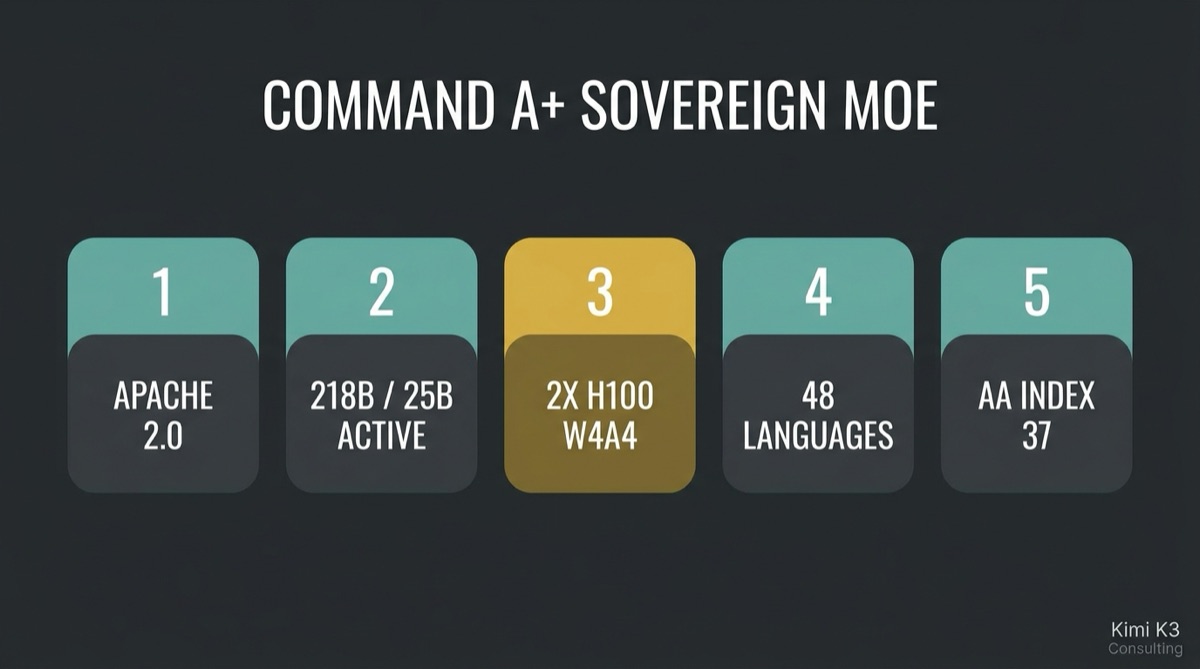
One model to replace a scattered Command fleet
North customer deployments drove consolidation; Command A+ unifies capabilities that used to ship as separate SKUs.
Cohere built Command A+ from a year of deploying North, its enterprise agent workspace. Previous Command variants split reasoning, vision, and translation across separate models. Command A+ merges those capabilities: reasoning, multimodal input, tool use, and multilingual support in one sparse MoE architecture.
“Command A+ is an efficient, versatile, and privately deployable LLM built for high-performance agentic tasks with minimal compute overhead.” – Cohere, Introducing Command A+
Internal North evaluations cited in the launch post show double-digit gains on agentic question answering (+20% vs Command A Reasoning), spreadsheet analysis (+32%), and memory usage quality (54% vs 39%). Treat those as vendor-internal harness scores, not independent leaderboard truth, but they signal design targets: MCP-connected file systems, uploaded spreadsheets, and cross-session memory.
Merits of the argument: Enterprises drowning in model SKUs pay integration tax on every new endpoint. A unified MoE with Apache 2.0 weights reduces vendor lock-in at the model layer while keeping Cohere’s managed path (Model Vault, API) optional.
Hardware honesty: two H100s, not a laptop
W4A4 quantisation is the enabler; ignoring the floor guarantees a science project.
Cohere publishes explicit hardware minima: BF16, FP8, and W4A4 quantisations on Hugging Face, with “imperceptible” quality differences at 4-bit in their testing. At W4A4, Command A+ is specified to run on as little as two NVIDIA H100s or one Blackwell B200.
“In practice, this enables Command A+ to run on as little as two NVIDIA H100s or a single NVIDIA Blackwell GPU, with virtually no quality degradation.” – Cohere, Introducing Command A+
Efficiency claims are concrete: up to 63% higher output tokens per second and up to 17% lower time to first token versus Command A Reasoning at matched quantisation and concurrency; W4A4 adds another 47% speed and 13% latency improvement in their measurements. Speculative decoding tuned for MoE adds a further 1.5–1.6× inference speedup.
Merits of the argument: Sovereign AI fails when procurement hears “open weights” and budgets zero GPUs. Cohere’s published floor gives capacity planners a number to challenge or accept.
Benchmarks and the AA Index 37
Public open-model positioning; verify on your workload, not on marketing tables alone.
On public agentic suites, Cohere reports τ²-Bench Telecom rising from 37% to 85% versus Command A Reasoning, and Terminal-Bench Hard from 3% to 25%. Multimodal scores include MMMU Pro at 63% and MathVista improvement to 80.6%.
“Command A+ achieved a score of 37 on the Artificial Analysis Intelligence Index , outperforming other leading open models, reflecting its strength as a general-purpose model for enterprise agentic workflows [3].” – Cohere, Introducing Command A+
Language coverage expanded from 23 to 48 languages, with tokenizer efficiency gains (20% fewer tokens for Arabic, 16% for Korean, 18% for Japanese versus predecessors). That matters for bill size on long multilingual agent traces.
Merits of the argument: AA Index 37 is a composite, not a guarantee on your RAG corpus or tool schema. It is still a useful cross-vendor anchor when comparing open weights against closed APIs at similar price tiers.
Failure cases
Case 1: “Sovereign” without network and weight governance
Teams download Apache 2.0 weights but serve them from a public endpoint with open ingress. Sovereignty requires checksum verification, private networking, egress allowlists, and audit logs, not just a licence header.
Case 2: Planning for one H100 because the headline said “efficient”
Minimum spec is two H100s at W4A4 (or one B200). Undersized clusters mean queue latency that kills agent loops, then blame on “MoE doesn’t work.”
Case 3: Treating North-internal +20% gains as your production SLA
Cohere’s North evaluations use LLM-as-judge on connected cloud file systems and spreadsheets. Your documents, MCP tools, and auth model will differ. Re-benchmark on frozen traces before migration.
Case 4: Ignoring quantisation ops
W4A4 is attractive on paper; vLLM tensor parallel setup, calibration, and regression tests against BF16 on your prompts are not free. Skipping validation invites silent quality drift on long-horizon tool calls.
Migration: from split Command endpoints to Command A+
- Inventory current Command endpoints (reasoning, vision, translate) and map each to Command A+ modality support.
- Size GPU footprint against published minima; budget B200 or 2× H100 per production slice, not peak demo.
- Pull W4A4 weights from Hugging Face; run parity evals on agent traces you already log.
- Re-test multilingual prompts that previously needed Command A Translate.
- Update tokenizer assumptions in cost models (fewer tokens per response in several languages).
- Keep Model Vault/API as fallback during cutover if self-host SRE capacity is thin.
When Command A+ is overkill
- Single-language FAQ bots with no tools and no document images.
- Batch embedding or rerank jobs better served by Cohere Embed/Rerank SKUs.
- Teams without GPU ops who will not use Model Vault or a managed provider.
- Regulated workloads where Apache 2.0 is fine but your policy mandates a different approved model list.
What to check right now
- Do you have 2× H100 (or B200) per isolated production environment, or a managed inference contract?
- Have you frozen 50–100 real agent traces for before/after Command A+ testing?
- Are MCP/tool permissions scoped per agent, not per “model server”?
- Did you re-price multilingual workloads with the new tokenizer efficiencies?
- Is W4A4 validated on your longest context prompts (128K input ceiling)?
- Who owns weight updates and checksum verification on your artifact store?
Sources and references
Primary links for every quotation and load-bearing number in this dossier. Verify before you reuse a figure elsewhere.
- Cohere – Introducing Command A+ – Apache 2.0, 218B/25B MoE, hardware minima, AA Index 37, efficiency and multilingual claims
- Artificial Analysis – Benchmarking Methodology – Intelligence Index and cost-per-task definitions
nJoy 😉