
July 2026 is the month open MoE stops being a niche hobby. Kimi K3 (2.8T MoE, weights promised by 27 July), DeepSeek V4 (MIT weights live since April preview), and GLM-5.2 (MIT on Hugging Face, API from Z.ai) all target long-horizon coding agents with 1M context and radically different sticker prices. The mistake is comparing $/MTok in a table and declaring a winner. The correct unit is cost-per-task under your harness, with license and self-host path in the same spreadsheet. Our earlier Kimi K3 routing dossier established that framing; this piece extends it across three open-family flagships.
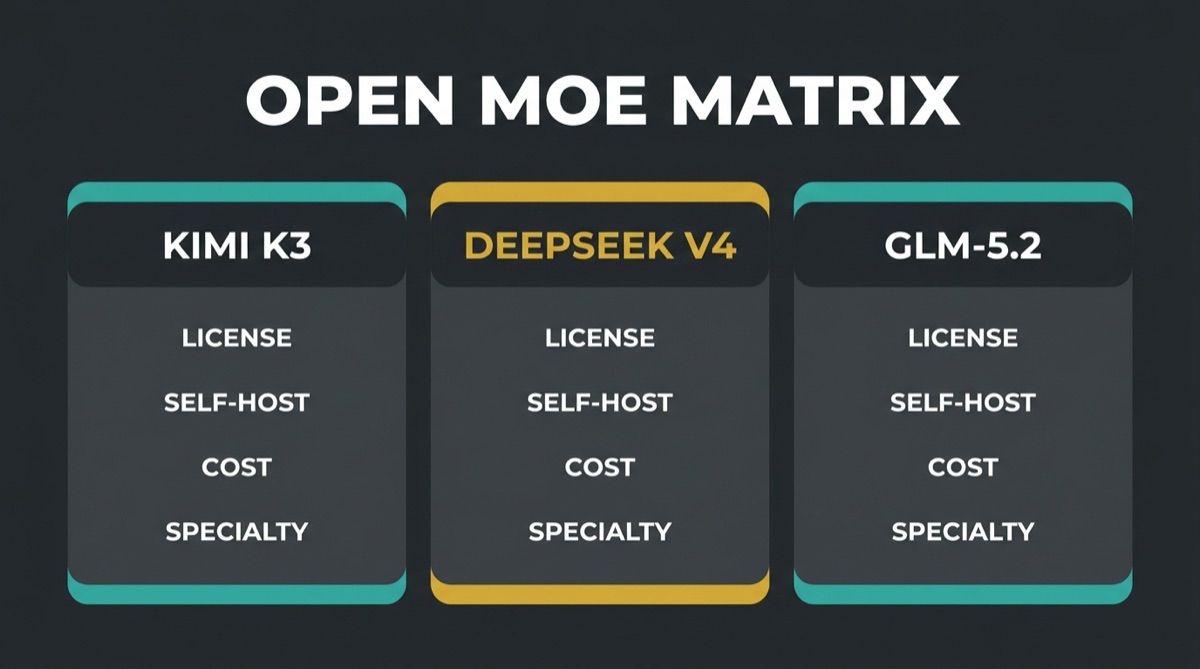
Three models, three open strategies
Scale vs sparse activation vs MIT drop · same agent buyer, different ops profile
Kimi K3 is Moonshot’s 2.8T-parameter open frontier play with Kimi Delta Attention, 1M context, and API pricing that assumes heavy prefix caching. DeepSeek V4 splits Pro (1.6T total, 49B active) and Flash (284B total, 13B active) with MIT weights already on Hugging Face. GLM-5.2 is Z.ai’s MIT-licensed 753B MoE flagship with 1M context and a mature Z.ai API tier list.
“Kimi K3 is a 2.8T-parameter model built on our Kimi Delta Attention and Attention Residuals, with native vision capabilities and a 1-million-token context window. It is the world’s first open 3T-class model, designed for frontier intelligence across long-horizon coding, knowledge work, and reasoning.” – Moonshot AI, Kimi K3 Tech Blog
“We present a preview version of **DeepSeek-V4** series, including two strong Mixture-of-Experts (MoE) language models — **DeepSeek-V4-Pro** with 1.6T parameters (49B activated) and **DeepSeek-V4-Flash** with 284B parameters (13B activated) — both supporting a context length of **one million tokens**.” – DeepSeek-V4-Pro README
“**Pure Open**: An MIT open-source license — no regional limits, technical access without borders” – GLM-5.2 README (Hugging Face)
Merits of the argument. All three vendors sell agentic coding narratives, but weight availability timing differs: DeepSeek and GLM-5.2 weights are downloadable now; Kimi K3 lists full weights by 27 July 2026. That affects compliance teams choosing self-host today vs wait-and-pin.
License and self-host matrix
MIT across the board · disk and GPU reality is not free
| Model family | License (official) | Weights status (Jul 2026) | Self-host note |
|---|---|---|---|
| Kimi K3 | Open weights release stated; follow Moonshot license on release | Full weights by 27 Jul 2026 (blog) | Moonshot recommends 64+ accelerator supernode for efficient serving; vLLM KDA cache contribution noted |
| DeepSeek V4-Pro | MIT (HF README) | Live on Hugging Face (~865 GB class instruct) | Official inference folder + vLLM/SGLang; Think Max needs large context budget |
| DeepSeek V4-Flash | MIT | Live (~160 GB class instruct per release blog) | Lower active params (13B) → cheaper GPU tier for many loops |
| GLM-5.2 | MIT (HF card) | Live zai-org/GLM-5.2 | Docs list vLLM, SGLang, Transformers, KTransformers builds |
Merits of the argument. MIT removes licensing friction for commercial fine-tunes and on-prem deployments. It does not remove capex: Pro-class MoE at 1M context is a datacentre decision, not a MacBook one.
Hosted API cost comparison (official list prices)
$/MTok is inputs to cost-per-task, not the final invoice
| Provider / model | Input (cache miss) / 1M | Input (cache hit) / 1M | Output / 1M |
|---|---|---|---|
Kimi API – kimi-k3 |
$3.00 | $0.30 | $15.00 |
DeepSeek – deepseek-v4-flash |
$0.14 | $0.0028 | $0.28 |
DeepSeek – deepseek-v4-pro |
$0.435 | $0.003625 | $0.87 |
| Z.ai API – GLM-5.2 | $1.40 | $0.26 | $4.40 |
“Pricing is $0.30/MTok for cache-hit input, $3.00/MTok for cache-miss input, and $15.00/MTok for output. Powered by Mooncake’s disaggregated inference architecture, the official Kimi API achieves a cache hit rate above 90% in coding workloads.” – Moonshot AI, Kimi K3 Availability
Merits of the argument. Sticker miss rates mis-rank Kimi: at 90% cache hits on coding workloads, effective input cost approaches $0.30 + 0.1×$3.00 = $0.60/M blended (before output). DeepSeek Flash is still cheaper on pure API arithmetic for uncached bursts, but may trade off peak agent quality on your hardest tasks. GLM-5.2 sits in the middle on price with strong long-context coding claims on the HF card.
When each model fits (honest trade-offs)
No single “best open MoE” · match model to task class
- Kimi K3: Long-horizon agent loops where Moonshot harness compatibility (thinking history preservation) and cache economics matter. Moonshot notes overall UX still trails Claude Fable 5 and GPT 5.6 Sol on experience, despite benchmark wins in places.
- DeepSeek V4 Flash: High-volume agent workers, chat, and cost-sensitive loops; upgrade to Pro when Flash max thinking fails eval gates.
- DeepSeek V4 Pro: Hard reasoning and agentic benchmarks where open weights and MIT matter; accept higher $/MTok and lower concurrency limit (500 vs Flash 2500 in API docs).
- GLM-5.2: Teams wanting MIT weights plus a mid-price API with 1M context and Z.ai coding-plan optionality; validate Terminal Bench / SWE claims on your harness, not HF footnotes alone.
Cross-link: routing patterns (planner/worker, oracle vs production router) from sudoall.com/kimi-k3-cost-per-task-routing-harness/ apply unchanged across these ids.
Failure cases
Open weights ≠ easy operations
- Kimi thinking-history sensitivity. Moonshot warns quality becomes unstable if harness strips historical thinking content or mid-session model swaps occur.
- Cache-assumed pricing. Kimi’s economic story collapses if your prompts never repeat prefixes (low cache hit).
- Self-host fantasy. Downloading MIT weights without a serving plan (quantisation, expert parallel, 1M KV cache) burns calendar time.
- Benchmark tourism. Each lab cites different harnesses (KimiCode, Claude Code, Codex); leaderboard numbers are not interchangeable.
Migration and fleet design
Start with API ids · add self-host when unit economics cross GPU breakeven
- Pick two API ids for shadow testing: e.g.
kimi-k3+deepseek-v4-flash, orglm-5.2+deepseek-v4-pro. - Log tokens, cache hits, latency, and task success for 100 production-shaped tickets each.
- Compute cost-per-successful-task (not cost-per-request).
- If monthly spend exceeds self-host capex threshold for your security zone, pilot MIT weights on a fixed GPU pool.
- Keep a closed-model escalation path for tasks where open models fail compliance or quality SLAs.
When open MoE is actually fine
Agent fleets with routing, caching, and fallback
- Engineering orgs with eval harnesses and willingness to run dual-provider routers.
- Regulated environments requiring weight custody (MIT self-host) even if API is cheaper short term.
- Batch overnight coding jobs where latency matters less than $/merged PR.
What to check right now
Checklist for platform leads
- Build the license/self-host/API matrix for your compliance team (use table above as starter).
- Measure cache hit rate on your current coding agent prompts (Kimi and DeepSeek both reward repeats).
- Download GLM-5.2 or DeepSeek-V4-Flash weights only if you have a serving owner; otherwise stay on API.
- Calendar Kimi K3 weight release (27 Jul 2026) if your policy requires local mirror on day zero.
- Re-read Moonshot K3 limitations (thinking history, excessive proactiveness) before defaulting agents.
Sources and references
Primary links for every quotation and load-bearing number in this dossier. Verify before you reuse a figure elsewhere.
- Moonshot AI – Kimi K3 Tech Blog – 2.8T MoE, 1M context, API pricing, cache hit claim, weight timing, limitations
- DeepSeek-V4-Pro README – MoE sizes, 1M context, MIT license
- DeepSeek API Docs – Models & Pricing – V4 Flash/Pro USD rates
- Z.ai – GLM-5.2 on Hugging Face – MIT license quote, 1M context, benchmark table
- Z.ai – API Pricing – GLM-5.2 $1.4 / $0.26 / $4.4 per 1M tokens
- sudoall.com – Kimi K3 cost-per-task routing harness – cost-per-task methodology
nJoy 😉