
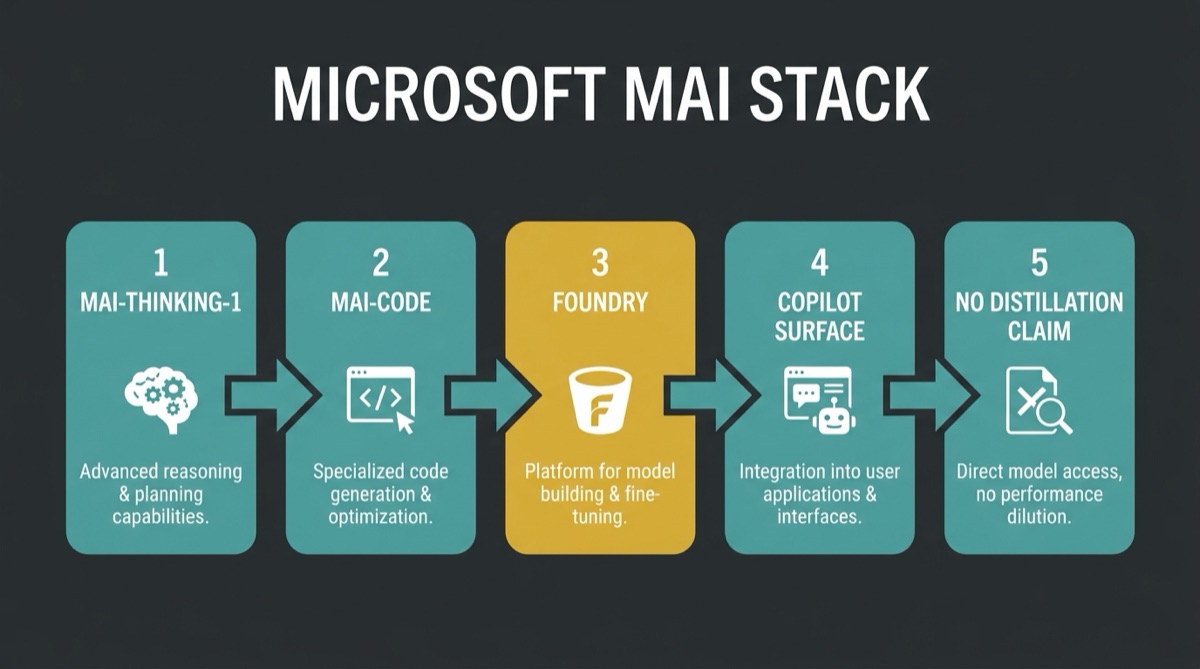
Microsoft Build 2026 was billed as an agentic platform story. Underneath the keynotes sits a sharper move: seven in-house MAI models, led by MAI-Thinking-1 for reasoning and a coding model rolling out through GitHub Copilot (Microsoft’s Build live blog names MAI-Code-1-Flash; the official Microsoft Build blog post calls it MAI-Code-1). Microsoft states these were trained from scratch on enterprise-grade data without distillation from third-party frontier models. That is Copilot independence as architecture and routing economics, not an overnight divorce from every OpenAI endpoint. This dossier reads the primary Microsoft sources carefully and separates verified claims from launch-stage benchmark marketing.
MAI-Thinking-1: mid-size MoE aimed at daily enterprise load
35 billion active parameters, 256K context, private preview on Foundry.
MAI-Thinking-1 is Microsoft AI’s first reasoning model. Microsoft positions it as strong in its weight class on software engineering benchmarks, mathematics, and blind human side-by-sides, whilst keeping inference footprint smaller than much larger dense models.
“MAI-Thinking-1 is a 35B-active, ~1T-total parameters, sparse Mixture of Experts model, a smaller inference footprint than much larger models. Despite this, our model is toe-to-toe with Claude Opus 4.6 on SWE-Bench Pro.” – Microsoft AI, Introducing MAI-Thinking-1
Enterprise features emphasised on the model page include a 256K token context window, function calling, multi-layer instruction following, and Chat Completions API compatibility via Microsoft Foundry security and compliance boundaries.
Merits of the argument: MoE at 35B active is a plausible daily-driver shape for document-heavy agents and long traces without Opus-class cost on every request. The SWE-Bench Pro claim is vendor-reported; treat it as a hypothesis until your repo harness confirms it.
Training story: learned, not distilled
Provenance and steerability as product claims, not footnotes.
Microsoft repeats a clear training constraint across the MAI-Thinking-1 post and the Azure Foundry blog: models trained from the ground up on clean, traceable, enterprise-grade data, without distillation from third-party frontier models.
“We don’t distill from other labs and we don’t rely on opaque data. Our datasets are clean, traceable, and enterprise-grade.” – Microsoft AI, Introducing MAI-Thinking-1
The Foundry blog adds the economic framing: MoE selectively activates only parts of the model per request, so “capability scales without compute scaling linearly,” aimed at high-volume, always-on workloads.
“MAI-Thinking-1 uses a Mixture-of-Experts (MoE) architecture that selectively activates only the parts of the model needed for each request. The result: capability scales without compute scaling linearly.” – Microsoft, New MAI models in Microsoft Foundry
Merits of the argument: For regulated customers, provenance beats leaderboard points. Distillation-free training is a procurement question auditors can ask; independent verification still requires eval on your data, not trust alone.
Copilot routing: MAI-Code alongside the catalog
Independence starts where Microsoft controls default model pickers and margin.
Microsoft’s Build blog states MAI-Code-1 is an inference-efficient coding model now available in Copilot and VS Code. The Build live blog adds that MAI-Code-1-Flash is purpose-built for GitHub Copilot and VS Code to deliver high performance and lower cost, with image, transcription, and voice models generally available on Foundry.
Crucially, Microsoft is not shrinking the catalog to MAI alone. The same keynote promises MAI models on Fireworks AI, Baseten, and Open Router, and Fireworks generally available on Foundry for governance with Azure data residency.
“Developer choice doesn’t stop at our catalog. MAI models will also be available on Fireworks AI, Baseten and Open Router.” – Microsoft, Microsoft Build 2026 blog
Merits of the argument: Copilot independence is partial and strategic: a first-party coding route for high-volume completions, whilst Foundry remains a multi-vendor marketplace. Operators should watch default routing in VS Code, not only model availability lists.
Failure cases
Case 1: Treating SWE-Bench Pro parity as your monorepo proof
Microsoft’s Opus 4.6 comparison is on a public benchmark harness. Your private codebase, test flakiness, and CI secrets will differ. Shipping MAI-Thinking-1 on benchmark faith alone invites regressions on internal frameworks.
Case 2: Assuming “no distillation” means “no OpenAI dependency anywhere”
MAI models do not require OpenAI weights, but Microsoft’s stack still integrates external models and OpenAI remains in the broader Azure/Copilot ecosystem. Independence is model lineage, not single-vendor isolation.
Case 3: Private preview confusion
MAI-Thinking-1 is private preview on Foundry whilst Copilot coding routes may be GA for individual tiers. Teams procuring “MAI everywhere” hit access walls if they never requested preview enrolment.
Case 4: Ignoring naming drift (MAI-Code-1 vs MAI-Code-1-Flash)
Primary Microsoft sources use both names. Automation that pins model IDs from blog posts alone may target the wrong endpoint. Confirm IDs in Foundry/Copilot docs at deploy time.
Migration: evaluate MAI without betting the fleet
- Request Foundry private preview for MAI-Thinking-1 if you need long-context reasoning agents.
- Enable MAI coding model in Copilot/VS Code picker for a pilot team; keep incumbent model as fallback.
- Run frozen traces from your agent logs on both models; measure pass rate, tokens, and wall time.
- Map compliance boundaries (Foundry region, logging, content filtering) before routing customer data.
- Document model IDs explicitly in repos; do not rely on marketing names alone.
- Revisit routing policy quarterly as Microsoft expands MAI across M365 Copilot and Foundry.
When staying on third-party models is fine
- Preview access unavailable and timelines are fixed.
- Your harness already tuned for Claude/GPT tool schemas and refusal behaviour.
- Benchmark-sensitive launches where external independent evals matter more than first-party claims.
- Multi-cloud strategy deliberately avoids Azure-native model lock-in.
What to check right now
- Which Copilot tier exposes MAI-Code / MAI-Code-1-Flash in your tenant’s model picker?
- Is MAI-Thinking-1 preview approved for your Foundry subscription and region?
- Do you have side-by-side SWE or agent traces logged for A/B testing?
- Are procurement contracts still OpenAI-weighted on inference spend despite MAI options?
- Who owns model ID pins in CI and local dev configs?
Sources and references
Primary links for every quotation and load-bearing number in this dossier. Verify before you reuse a figure elsewhere.
- Microsoft AI – Introducing MAI-Thinking-1 – architecture, SWE-Bench Pro claim, training constraints, enterprise features
- Microsoft – New MAI models in Microsoft Foundry – MoE economics, modality lineup, preview/GA status
- Microsoft – Build 2026 official blog – seven-model family, Copilot availability, multi-provider routing
- Microsoft – Build 2026 live blog – MAI-Code-1-Flash naming (secondary corroboration only; not used for blockquotes)
nJoy 😉