
Google’s Gemini 3.6 Flash launch is not another leaderboard flex. It is a pricing memo dressed as a model card: agent economics are won on output tokens per task, tokens per second at the leaf tier, and whether your orchestrator stops paying flagship prices for sub-agent busywork. Benchmarks still matter for capability floors. In production agents, token efficiency is the product.

3.6 Flash: fewer tokens, lower tariff
Artificial Analysis Index · DeepSWE · GDPval-AA v2 · $/MTok
Gemini 3.6 Flash is explicitly framed as the workhorse for coding, knowledge work, and multimodal agent loops. Google cites Artificial Analysis Index data showing 17% fewer output tokens than 3.5 Flash on aggregate, with DeepSWE (Datacurve) showing up to 65% reduction in some cases, plus fewer reasoning steps and tool calls on multi-step workflows. That is not a cosmetic tweak. If your agent bill is dominated by output tokens on tool-heavy graphs, a mid-teens efficiency gain compounds across every sub-call.
“For example, on the Artificial Analysis Index, we see 3.6 Flash consuming 17% fewer output tokens than 3.5 Flash.” – Google, Introducing Gemini 3.6 Flash, 3.5 Flash-Lite, and 3.5 Flash Cyber
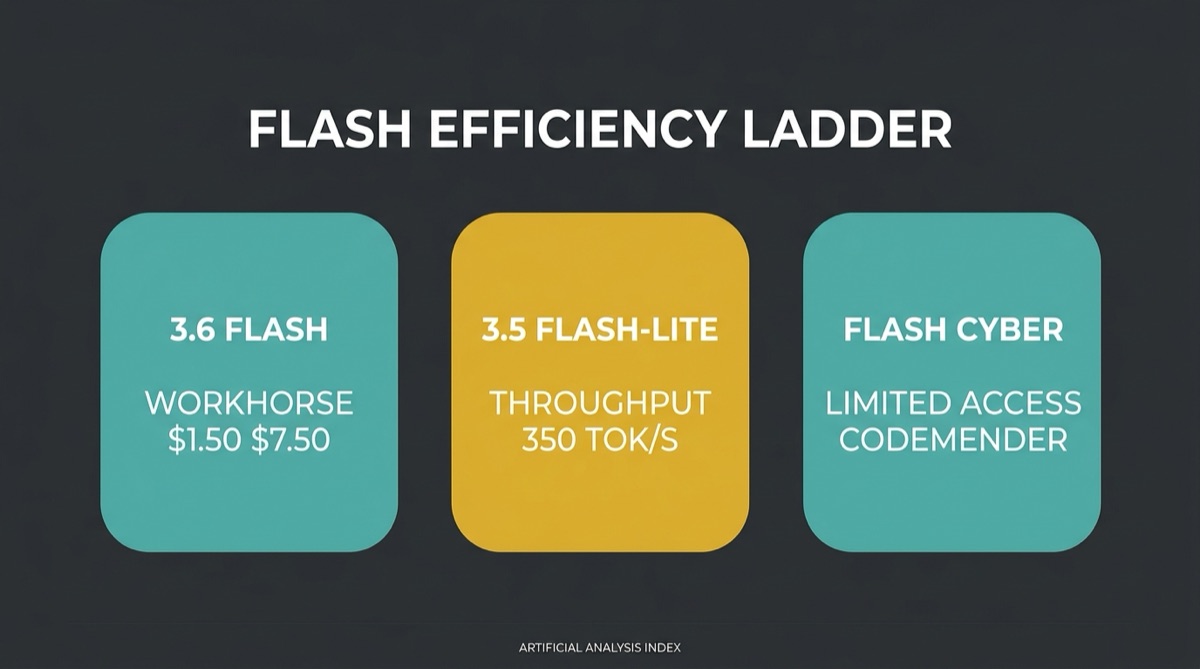
Pricing reinforces the story: $1.50 per million input tokens and $7.50 per million output tokens, lower than 3.5 Flash on both sides. Google reports gains on DeepSWE (49% vs 37%), MLE Bench (63.9% vs 49.7%), OSWorld-Verified (83.0% vs 78.4%), and GDPval-AA v2 (1421 vs 1349). Computer use is now a built-in client-side tool via the Gemini API and Gemini Enterprise, which matters for agents that previously paid orchestration tax wrapping brittle UI automation.
“At $1.50/1M input tokens and $7.50/1M output tokens, 3.6 Flash reduces the overall cost per agentic task, making agents more cost-effective to build and run.” – Google, Introducing Gemini 3.6 Flash, 3.5 Flash-Lite, and 3.5 Flash Cyber
Merits of the argument. Google ties efficiency claims to named benchmarks and a public price sheet, not vibes. The 17% AA Index figure is an aggregate; workload-specific wins (DeepSWE up to 65%) will not transfer uniformly to your stack. Still, pairing lower $/output with fewer outputs is the correct lever for agent TCO. This is the same operational frame as cost-per-task routing: sticker $/MTok misleads; cost per completed task is the metric that survives finance review.
3.5 Flash-Lite: throughput for the leaf tier
350 tok/s · thinking levels · sub-agent fan-out
Flash-Lite targets high-volume, high-throughput agentic search, document processing, and sub-agent fan-out. Artificial Analysis measures 350 output tokens per second. Pricing is $0.30 per million input and $2.50 per million output, with Google claiming large jumps over 3.1 Flash-Lite on Terminal-Bench 2.1 (54% vs 31%), GDM-MRCR v2 (72.2% vs 60.1%), and GDPval-AA v2 (1140 vs 642). On several agentic and coding evals, Google states 3.5 Flash-Lite even beats 3 Flash, including SWE-Bench Pro (54.2% vs 49.6%) and OSWorld-Verified (74.0% vs 65.1%).
“Priced at $0.3/1M input tokens and $2.5/1M output tokens and with significantly better quality than 3.1 Flash-Lite, 3.5 Flash-Lite offers a strong price-to-performance ratio for developers and customers running high throughput production traffic.” – Google, Introducing Gemini 3.6 Flash, 3.5 Flash-Lite, and 3.5 Flash Cyber
Google’s own examples show the pattern: 3.6 Flash as master agent, Flash-Lite instantly generating 25 web design concepts, or scaling receipt translation. That is textbook tiered orchestration from routing by task complexity: one planner with strong tool discipline, many cheap parallel workers with configurable thinking levels (minimal/low for latency, higher for multi-step subagents).
Merits of the argument. Throughput and price are verifiable product claims; benchmark deltas are vendor-selected. Flash-Lite is not a substitute for 3.6 Flash on hard migration or precision coding; Google positions it as scale tier. The mistake is running everything on 3.6 because it is “best,” or everything on Lite because it is cheap. The win is explicit routing.
3.5 Flash Cyber and the dual-use split
CodeMender · CyberGym · government and trusted partners only
Flash Cyber is fine-tuned from 3.5 Flash for vulnerability find-and-fix at lower cost per token than larger models, deployed inside CodeMender with multiple agents producing a combined report. CyberGym scores are cited as competitive at the frontier. Access is deliberately narrow:
“Given the dual-use nature of this technology, we have taken an intentional approach to deploying 3.5 Flash Cyber. The model will be exclusively available to governments and trusted partners via CodeMender soon as part of a limited-access pilot program.” – Google, Introducing Gemini 3.6 Flash, 3.5 Flash-Lite, and 3.5 Flash Cyber
3.6 Flash ships with enhanced Frontier Safety safeguards on CBRN and cyber offence misuses, trained to resist jailbreaks whilst minimising refusals on beneficial uses. General developers get safer workhorse models; cyber-offence-shaped capability is gated, not sprinkled into the default API tier.
Merits of the argument. Google mirrors the industry split between general agent stacks and trusted cyber programmes. Flash Cyber is irrelevant to most product teams today, but it signals where Google thinks efficiency gains will also appear in security automation. Do not plan production architecture assuming Cyber API access; plan assuming CodeMender-style partnership gates.
Named failure cases
Single-model agents · ignoring thinking levels · benchmark tourism
| Failure mode | Symptom | Fix |
|---|---|---|
| Monolithic 3.6 everywhere | High-quality outputs on trivial subtasks; bill looks like flagship routing | Route leaf tasks to Flash-Lite with minimal thinking; reserve 3.6 for planner/reviewer roles |
| Lite for everything | Cheap runs that loop on tool errors or miss long-context structure | Promote failed subtasks to 3.6; cap Lite to bounded prompts with schema outputs |
| Sticker $/MTok budgeting | Finance approves Lite pricing; ops sees 4× output tokens on verbose agents | Track cost per task with AA-style output token counts; see sudoall cost-per-task routing |
| Ignoring thinking level knobs | Paying high-reasoning latency on bulk extraction | Map thinking levels to task classes; document defaults in agent manifest |
| Benchmark-driven model pick | Choosing 3.6 because DeepSWE headline without measuring your tool graph | Run 50–100 production traces; compare output tokens and success rate, not leaderboard rows alone |
| Assuming Flash Cyber in prod | Architecture depends on vuln-hunting model users cannot access | Separate red-team/purple-team pipeline with explicit trusted access; keep app tier on 3.6/Lite |
Migration steps
- Baseline current agent spend by role (planner, worker, reviewer) using last 30 days of traces. Split input vs output tokens.
- Promote planner/reviewer to 3.6 Flash on Gemini API or Enterprise; enable computer use only where UI automation is load-bearing.
- Move fan-out workers to 3.5 Flash-Lite with minimal or low thinking for search, summarisation, and parallel ideation.
- Implement retry escalation: Lite failure or tool-loop threshold triggers 3.6 re-run with tighter instructions (pattern from multi-agent playbooks in multi-agent coordination).
- Re-measure output tokens per successful task after two weeks; compare to pre-migration, not to Google’s benchmark table.
- Track Gemini 4 pretraining note as planning horizon only. Google states its “most ambitious pre-training run yet” for Gemini 4 is underway; do not defer migration waiting for it. Efficiency discipline compounds now.
When it is actually fine
Low-volume prototypes · single-step tools · non-agent chat
Staying on one Flash tier is reasonable when: traffic is low enough that routing complexity exceeds savings; tasks are single-shot without tool graphs; or you are still proving product fit and need one model ID for simpler telemetry. Flash-Lite alone is fine for batch document pipelines with fixed schemas and no planner. 3.6 alone is fine for small teams running dozens of agent sessions daily, not thousands.
Google also notes 3.5 Pro testing with partners and Gemini 4 pretraining in parallel. None of that invalidates shipping tiered Flash routing today.
What to check right now
- Pull output tokens per successful agent task for your current default Gemini model.
- Identify sub-agent calls that never need computer use or high thinking; candidate list for Flash-Lite.
- Confirm Gemini API model IDs and thinking level parameters in your orchestrator manifest.
- Compare $7.50/MTok 3.6 output vs $2.50/MTok Lite on your top five recurring workflows with real prompts.
- If cyber automation is in scope, verify whether you are in CodeMender trusted access; if not, remove Flash Cyber from architecture diagrams.
- Read 3.6 Flash and 3.5 Flash-Lite model cards for safety/refusal changes that affect your domain (finance, health, code execution).
Sources and references
Primary links for every quotation and load-bearing number in this dossier. Verify before you reuse a figure elsewhere.
- Google – Introducing Gemini 3.6 Flash, 3.5 Flash-Lite, and 3.5 Flash Cyber (21 Jul 2026) – pricing, AA Index 17% output token reduction, 350 tok/s Flash-Lite, CodeMender/Flash Cyber access model, Gemini 4 pretraining note, benchmark tables
- sudoall – Kimi K3 cost-per-task routing harness – cost-per-task vs sticker token pricing
- sudoall – LLM routing by task complexity – planner/worker tier selection
- sudoall – Multi-agent coordination 2026 playbook – orchestration, escalation, and containment patterns
nJoy 😉