
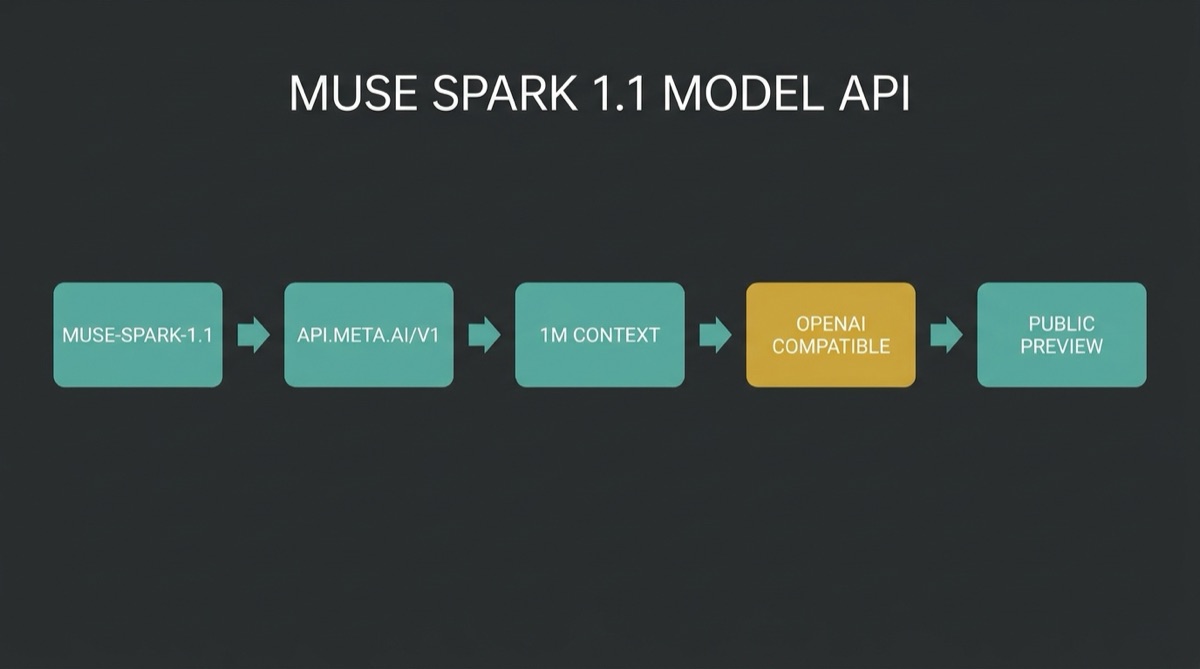
Meta’s Muse Spark 1.1 release is not just a model bump. It pairs a multimodal agentic model with the first public preview of the Meta Model API: OpenAI-compatible, Anthropic-compatible, base URL https://api.meta.ai/v1, model id muse-spark-1.1, and a 1M-token context window. For teams already running OpenCode, Claude Code, or LangChain against other vendors, the migration cost is mostly configuration, not a rewrite. The hard part is deciding whether Meta’s agentic story (computer use, subagents, context compaction) matches your production harness before you route real customer traffic.

Muse Spark 1.1: agentic and multimodal
Planning, tools, computer use, and coding in one model · public preview API
Meta Superintelligence Labs describes Muse Spark 1.1 as a significant upgrade focused on tool and computer use, coding, and multimodal understanding. The model is positioned for personal agentic tasks that require planning across external apps, MCP servers, and custom skills, with explicit training for multi-agent orchestration and 1M-token context management.
“Muse Spark 1.1 is a multimodal reasoning model built for agentic tasks, with major gains in tool and computer use, coding, and multimodal understanding.” – Meta, Introducing Muse Spark 1.1
“Along with this release, we are launching a public preview of the new Meta Model API where developers can access Muse Spark 1.1.” – Meta, Introducing Muse Spark 1.1
Merits of the argument. Meta is shipping API access in the same beat as the model, which reduces the usual “model exists but no stable endpoint” gap. Safety evaluation references (Advanced AI Scaling Framework) are documented in the blog; still run your own red-team suite before customer-facing agents.
Meta Model API: drop-in compatibility
Same auth, three request shapes · OpenAI and Anthropic SDK paths
The developer docs state plainly that Meta Model API is drop-in compatible with OpenAI SDK, Anthropic SDK, and agent CLIs such as OpenCode and Claude Code. You point the client at the base URL, set MODEL_API_KEY, and choose Responses, Chat Completions, or Messages depending on what your harness already speaks.
“Muse Spark 1.1 can actively manage its context window of 1 million tokens.” – Meta, Introducing Muse Spark 1.1
“For the first time, developers can begin building with Muse Spark 1.1 via the new Meta Model API, now in public preview.” – Meta, Introducing Muse Spark 1.1
| Parameter | Official value |
|---|---|
| Base URL | https://api.meta.ai/v1 |
| Model | muse-spark-1.1 |
| Context window | 1,048,576 tokens |
| Auth | Bearer token (MODEL_API_KEY) |
Merits of the argument. Tri-format support lowers lock-in for mixed fleets (Codex-style Responses in one repo, Claude Code Messages in another). Docs warn that reasoning continuity requires include: ["reasoning.encrypted_content"] on OpenCode-style setups; skipping that is a silent quality regression in multi-turn tool loops.
Pricing and rate limits
Pay-as-you-go USD · no long-context premium on listed rates
Meta bills per token with no minimum commitment. Listed rates (public preview) are $1.25/M input, $0.15/M cached input, and $4.25/M output. Search grounding adds $2.50 per 1,000 queries on top of token charges. Meta explicitly states there is no long-context premium on the published per-token rates.
Meta Model API docs (client-rendered) list $1.25/M input, $0.15/M cached input, and $4.25/M output, and state there is no long-context premium on those listed per-token rates. Confirm on the live pricing page before budgeting 1M-context agent fleets.
Merits of the argument. For 1M-context agent runs, flat pricing simplifies forecasting versus vendors that surcharge long prompts. You still pay for filled context on every turn unless prompt caching hits; monitor cached_tokens in responses.
Failure cases in agent deployments
Preview API, reasoning replay, and computer-use scope
- Public preview instability. Preview APIs can change rate limits, features, or pricing; pin versions in runbooks and expect changelog drift.
- Broken reasoning replay. Multi-step agents without encrypted reasoning carry-over re-plan from scratch each turn (documented OpenCode tradeoff).
- Computer-use overreach. Models trained for desktop automation may script when a direct click is safer; constrain tools in production.
- Partner quotes ≠ your eval. CEO testimonials on the release blog are marketing signal, not your SOC2 agent scorecard.
Migration: wire your harness in two steps
Dashboard key → provider block → muse-spark-1.1
Official flow: create MODEL_API_KEY, export it, then register a provider with base URL https://api.meta.ai/v1 and model muse-spark-1.1. OpenCode users can paste Meta’s documented provider block (Responses API via @ai-sdk/openai) including reasoning settings and 1,048,576 context limit.
curl -X POST "https://api.meta.ai/v1/responses"
  -H "Authorization: Bearer $MODEL_API_KEY"
  -H "Content-Type: application/json"
  -d '{
  "model": "muse-spark-1.1",
  "input": "What is the capital of France?"
}'
When Muse Spark 1.1 is actually fine
Multimodal agents with existing OpenAI-shaped code
- Greenfield agent stacks already on OpenAI SDK or Vercel AI SDK where swapping base URL is low risk.
- Workflows needing image, PDF, or video in the same agent loop as tool calls (modalities documented in OpenCode config).
- Internal coding agents where Meta Internal Coding Bench directionally matches your repo scale (validate locally).
What to check right now
Checklist before production routing
- Confirm preview ToS and data handling for your compliance tier.
- Enable reasoning replay settings if your harness uses multi-turn tools.
- Benchmark
muse-spark-1.1vs your incumbent on 50 real tickets (coding + tool-heavy). - Track cached vs uncached input tokens for cost forecasts.
- Set RPM/TPM backoff (docs recommend exponential backoff with jitter on 429).
Sources and references
Primary links for every quotation and load-bearing number in this dossier. Verify before you reuse a figure elsewhere.
- Meta – Introducing Muse Spark 1.1 – model capabilities, Meta Model API public preview, agentic/computer-use positioning
- Meta Model API – Overview – base URL, model id, context window, SDK compatibility
- Meta Model API – Pricing and rate limits – $1.25 / $0.15 / $4.25 per 1M tokens, search grounding surcharge, rate limits
nJoy 😉