
Chart Patterns Course – Chapter 2 of 10. A pattern without context is like a sentence without grammar. You can stare at the letters all day and still miss the meaning. Market structure is the grammar. Trend, support, resistance, volume, and auction behaviour are what tell you whether a shape is a continuation pause, a failed auction, or just decorative noise.
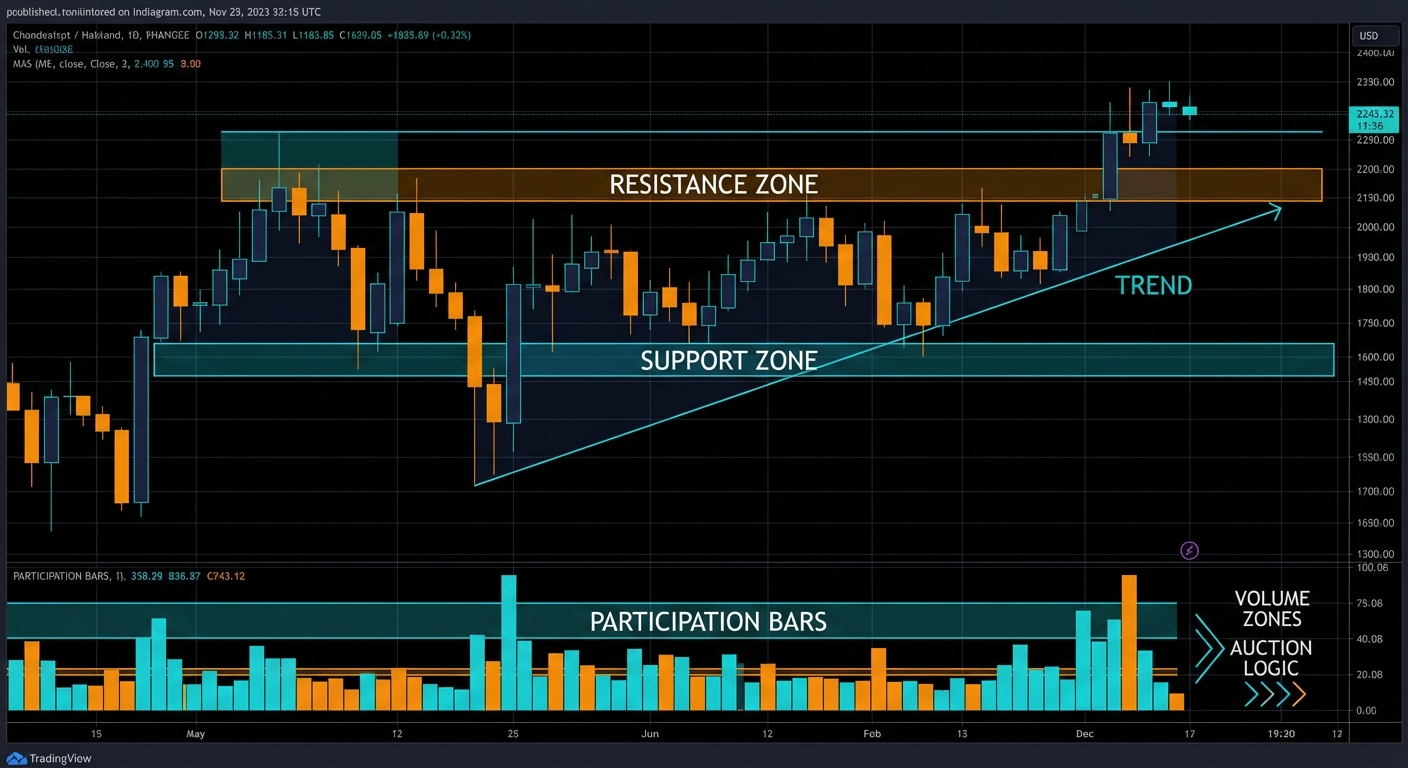
Trend Comes First
Every pattern sits inside a larger directional state. That is where good technical analysis starts. If price is making higher highs and higher lows, your default lens should be trend continuation or trend pause until proven otherwise. If price is making lower highs and lower lows, the burden of proof is on any bullish-looking setup. If the market is chopping sideways, many patterns are simply range noise wearing a formal costume.
CME’s educational material on trend analysis is helpful here because it is blunt: trend-following signals are always somewhat late, but the late signal is often still better than pretending no trend exists. That trade-off matters. A pattern trader who refuses to classify the larger trend is basically trying to trade syntax without semantics. The shape may look correct, yet its meaning changes dramatically depending on the broader move wrapped around it.
Support and Resistance Are Zones, Not Laser Beams
Support and resistance are best understood as areas where the market has repeatedly hesitated, reversed, accelerated, or found liquidity. Retail teaching often turns them into exact lines, which is convenient for screenshot culture and terrible for live trading. Real markets breathe around levels. Stops cluster around obvious highs and lows. Limit orders rest near prior turning points. Participants remember price areas more than perfect ticks.
Carol Osler’s work at the New York Fed is one of the strongest institutional reasons not to dismiss this subject outright. Her paper on support and resistance found strong evidence that these levels helped predict intraday trend interruptions in FX. That does not mean every line on every chart matters. It means some trader-watched levels do carry real information, and the information likely exists because actual orders cluster around them.
“These tests strongly support the claim that support and resistance levels help predict intraday trend interruptions for exchange rates.” – Carol Osler, Federal Reserve Bank of New York
That finding is powerful because it moves support and resistance out of motivational-poster territory and into something closer to observable market behaviour. It also supports a key principle for the rest of this course: patterns matter more when they are anchored to levels that market participants already care about.
Volume Is Participation, Not Magic
Volume is often taught badly. Some teachers present it as a universal lie detector, as if one spike settles all debates. A better way to teach it is participation. Higher-than-normal volume suggests more market involvement in the move. That can strengthen the interpretation of a breakout, a reversal, or a rejection. Low participation does not automatically invalidate a setup, but it should make you more suspicious of aggressive conclusions.
The CMT Association’s work on volume and volatility is useful because it ties participation to context rather than mythology. Rising activity into a breakout can support the idea that the market is accepting price outside a prior range. Shrinking activity inside a congestion structure can support the idea that volatility compression is building toward expansion. The point is not to worship volume. The point is to use it as one piece of market-state evidence.
The Auction Logic Underneath Patterns
Markets are ongoing auctions. That phrase sounds academic until you map it onto chart behaviour. When buyers and sellers are in temporary balance, price rotates in a range. When one side overwhelms the other, price migrates. Patterns are visual snapshots of those shifts. A rectangle is a balance area. A breakout is attempted acceptance outside that area. A false breakout is failed acceptance, where price briefly escapes and then is dragged back inside because follow-through does not hold.
This auction perspective is more useful than simply memorising shapes because it gives you a causal story that is compatible with real order flow. Osler’s staff work on currency orders is especially valuable here. It links support, resistance, stop-loss clustering, and acceleration after breaks to actual order placement by participants. That is a much better foundation than a vague story about mysterious actors hunting retail traders for sport.
# Context-first logic
if trend_up and price_near_support_zone and participation_improving:
    look_for_continuation_or_bullish_reversal()
elif range_bound and repeated_rejection_at_highs:
    treat_breakout_or_failure_as_key_information()
Why Context Changes Pattern Meaning
Consider a triangle. Inside a strong weekly uptrend, after a sharp directional move, it may function as a continuation pause. Inside a dull sideways market, the same triangle can simply be indecision. Near a major higher-timeframe resistance zone, it may be an exhaustion structure that fails upward and reverses. The pattern did not change. The context changed. That is why market structure is not optional theory. It is the thing that determines what the pattern is trying to say.
That same rule applies to support and resistance polarity shifts. Broken resistance often becomes support, not because of a mystical law, but because prior sellers may become trapped buyers and new participants may now defend the breakout area. Broken support can become resistance for the same reason. Pattern trading works better when you understand that memory and positioning live around these zones.
What A Serious Pattern Trader Checks First
Before naming the shape, check five things. First, what is the higher-timeframe trend? Second, is the market near a meaningful zone? Third, is participation expanding, shrinking, or indifferent? Fourth, is price behaving like balance or imbalance? Fifth, is the venue itself suitable for interpretation? Futures volume tells cleaner stories than fragmented off-exchange volume in some markets. Good context work is boring, which is exactly why it saves money.
Summary Takeaway
Market structure is the context layer that makes a chart pattern interpretable. Trend, support and resistance zones, volume as participation, and auction logic all matter more than the shape alone. If you skip context, you are trading silhouettes.
Course Navigation
Previous: Chart Patterns Foundations: What They Are and What They Are Not
Next: Reversal Chart Patterns: Head and Shoulders, Double Tops, and Double Bottoms
Full course: Chart Patterns Course – Evidence, Execution, and Risk
This chapter is part of the Chart Patterns Course.