
LLM Architecture Series – Lesson 19 of 20. You now understand the core architecture. Scaling is about what happens when we make models wider, deeper, and train them on more data.
Surprisingly, performance often follows smooth scaling laws, which lets practitioners predict the benefit of using larger models.
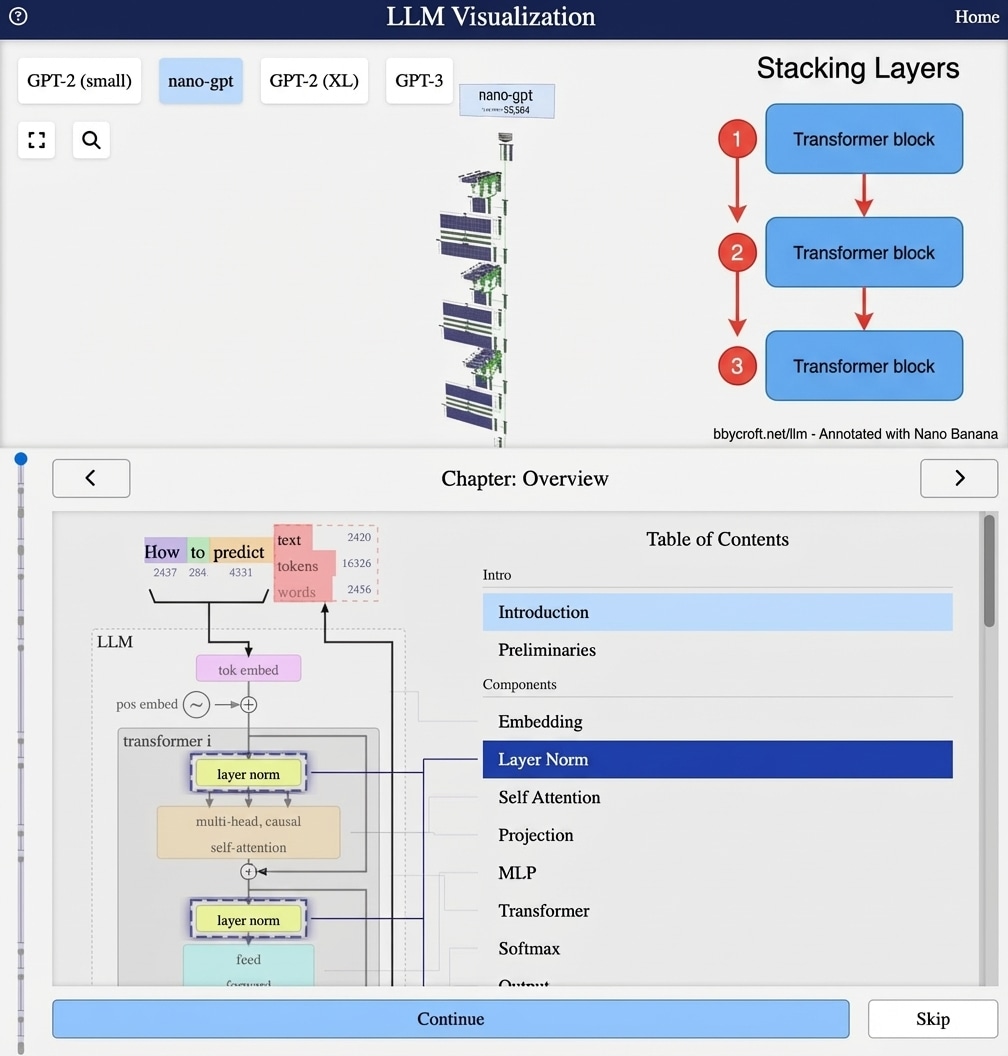
Visualization from bbycroft.net/llm augmented by Nano Banana.
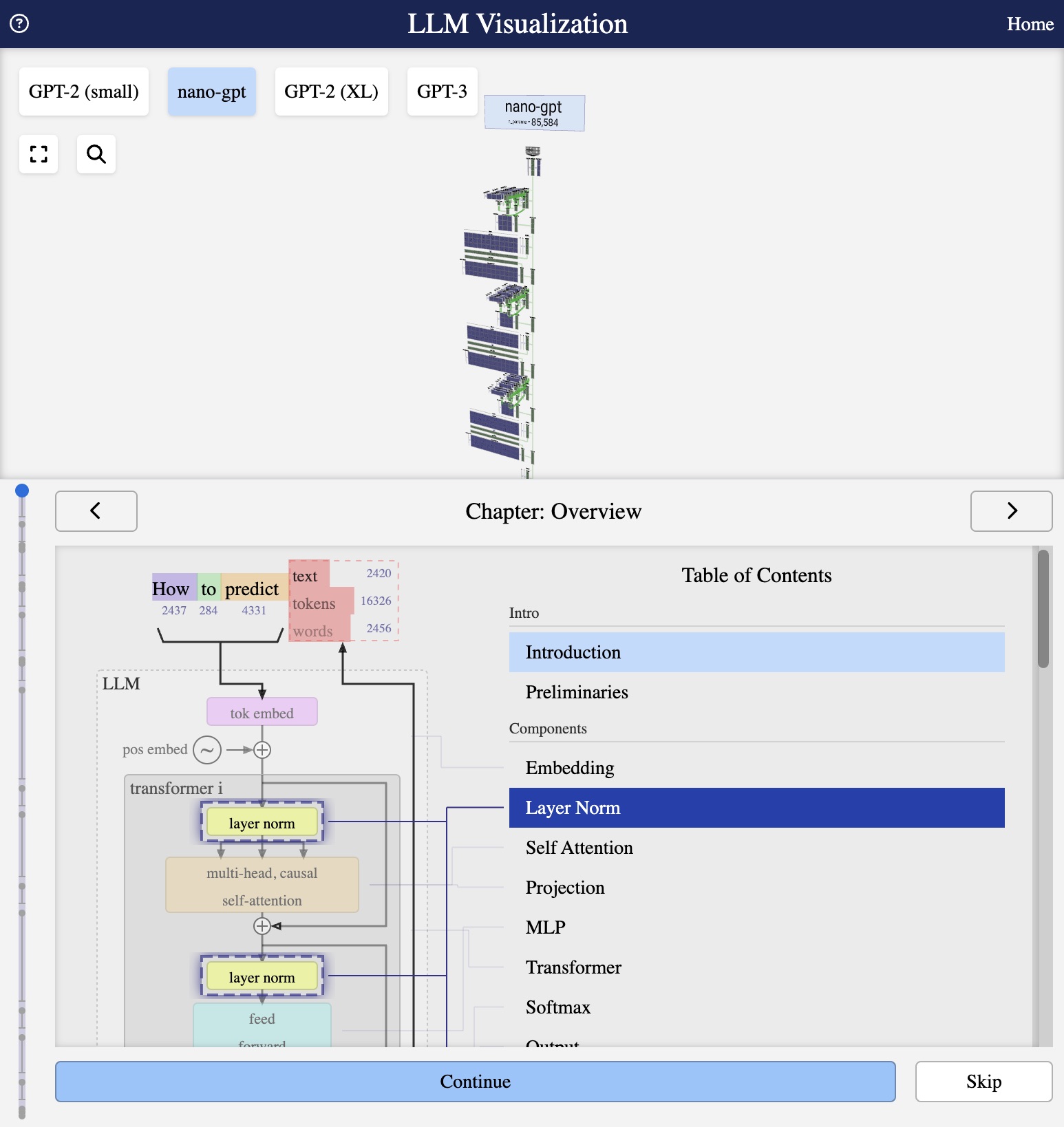
Visualization from bbycroft.net/llm
The Same Architecture, Different Scales
The remarkable thing about transformer LLMs is that the architecture stays the same from tiny to massive. Only three things change: depth, width, and data.
Model Configurations
| Model | d_model | Layers | Heads | Parameters |
|---|---|---|---|---|
| nano-gpt | 48 | 3 | 3 | 85K |
| GPT-2 Small | 768 | 12 | 12 | 117M |
| GPT-2 Medium | 1024 | 24 | 16 | 345M |
| GPT-2 Large | 1280 | 36 | 20 | 762M |
| GPT-2 XL | 1600 | 48 | 25 | 1.5B |
| GPT-3 | 12288 | 96 | 96 | 175B |
Scaling Laws
Research has shown predictable relationships:
Loss ∝ 1 / (Parameters)0.076
More parameters = better performance, following a power law.
Compute Scaling
Training cost scales roughly as:
- Parameters × Tokens × 6 FLOPs
- GPT-3 training: ~3.14 × 10²³ FLOPs
- Equivalent to thousands of GPU-years
Emergent Capabilities
Larger models don’t just do the same things better – they gain new abilities that smaller models lack entirely.
Series Navigation
Previous: Output Softmax
Next: The Complete LLM Pipeline
This article is part of the LLM Architecture Series. Interactive visualizations from bbycroft.net/llm.
Analogy and intuition
Scaling is like building a bigger library and hiring more librarians. With more books and more staff you can answer more complex questions, but you also pay higher costs.
Finding the right scale is about balancing capability, latency, and hardware budget for a given application.
Looking ahead
The final lesson will connect all steps into one clear pipeline from raw text input to generated output.