
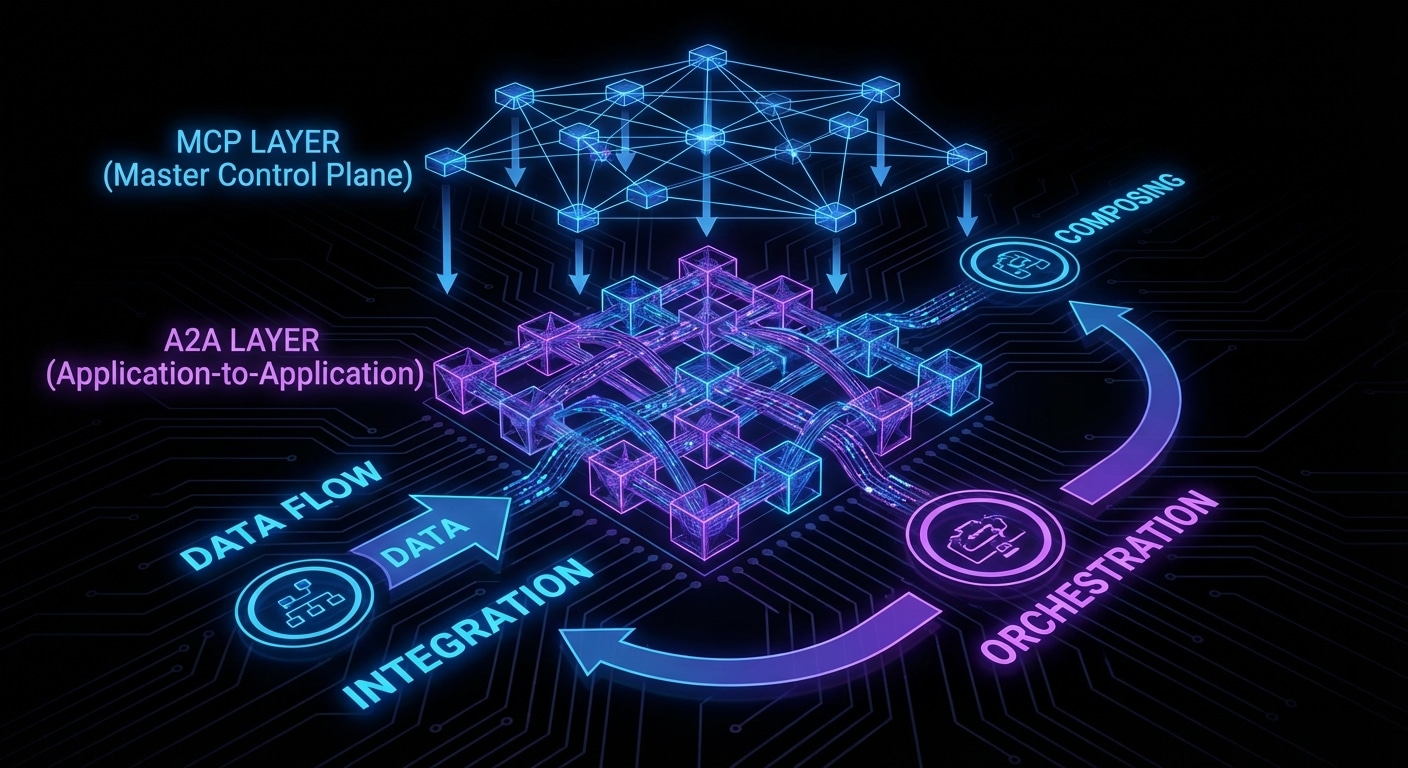
Once you have MCP for tools and something like A2A for agent-to-agent handoffs, the next step is composing them: one system that uses both. For example, your main agent might call MCP tools (search, DB, API) and also delegate sub-tasks to other agents via A2A. The orchestrator (often an LLM or a small controller) decides when to use a tool and when to call another agent, and it merges results back into the main flow.
Orchestration patterns vary. You can have a single orchestrator that never delegates — it only uses MCP tools. You can have a tree: the top agent delegates to specialists, and each specialist might use tools or delegate again. You can have a pipeline: agent A does step 1, hands to B for step 2, then to C for step 3. The choice depends on the task. Composing MCP and A2A means the orchestrator has two kinds of “actions”: call a tool (MCP) or delegate to an agent (A2A). Both return something the orchestrator can reason over.
Design questions: who owns the overall goal and context? Usually the top-level agent or the host. How do you avoid infinite delegation? Step limits, timeouts, and clear contracts (e.g. “return by time T”). How do you handle partial failure? One agent might fail; the orchestrator needs a strategy (retry, fallback, or abort and report).
In production you’ll also care about observability (tracing which agent did what), cost (each agent call may hit an API), and security (which agents can call which tools or other agents). Composing MCP and A2A gives flexibility; making that composition reliable and debuggable is the next layer of work.
Expect more frameworks that support both MCP and A2A in one stack, and clearer patterns for when to delegate versus when to call a tool.
nJoy 😉