
Ichimoku Trading Series: Part 8 of 10 | ← Previous | View Full Series
The backtesting.py Framework
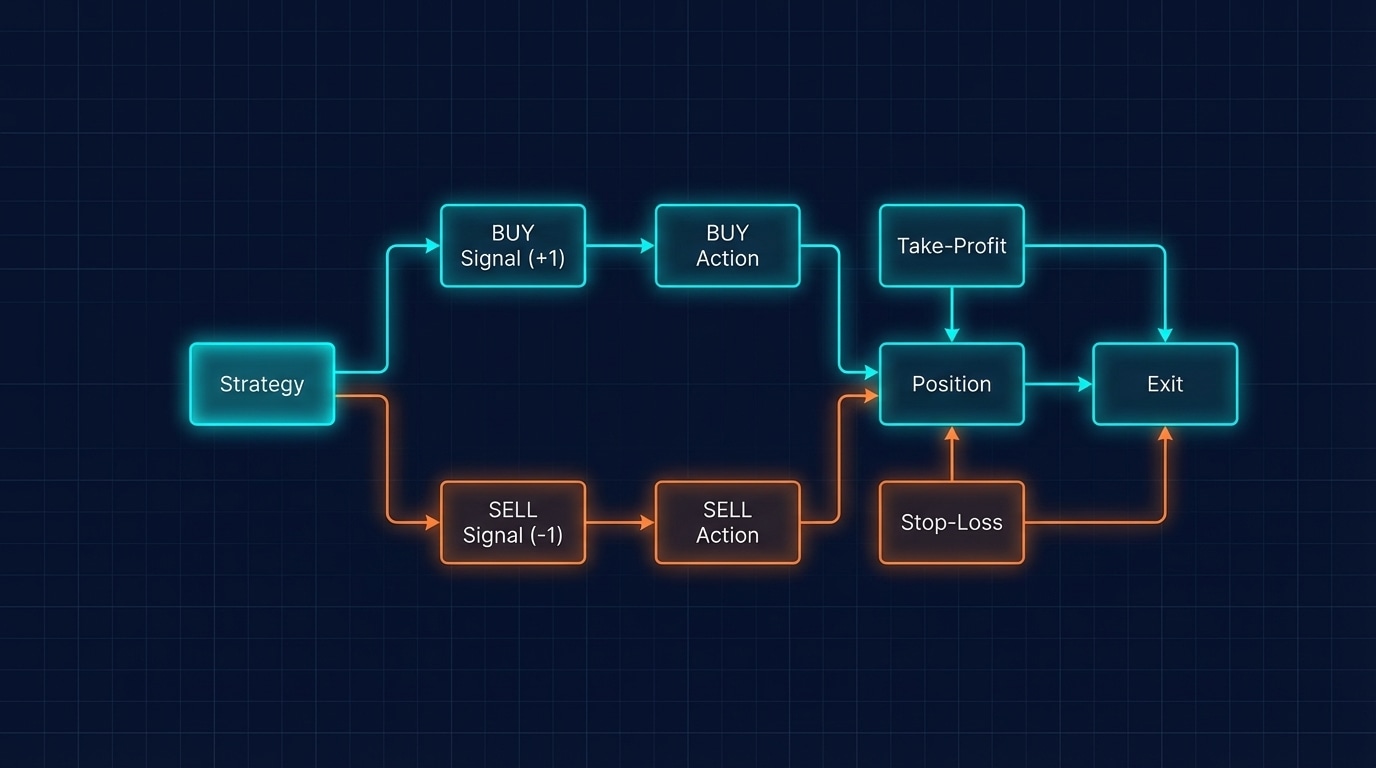
The backtesting library uses a class-based approach where:
init()runs once at the startnext()runs on every candle
Complete Strategy Class
from backtesting import Strategy

class SignalStrategy(Strategy):
    """
    Ichimoku + EMA trend-following strategy.

    Entry: Pre-computed signal column (+1 long, -1 short)
    Exit: ATR-based SL and RR-based TP
    """

    # Class-level parameters (can be optimized)
    atr_mult_sl: float = 1.5   # SL distance = ATR x this
    rr_mult_tp:  float = 2.0   # TP distance = SL x this

    def init(self):
        """Initialize indicators (we pre-compute, so nothing needed here)."""
        pass

    def next(self):
        """Called on every bar. Check for signals and manage positions."""
        i = -1  # Current bar
        signal = int(self.data.signal[i])   # +1 long, -1 short, 0 none
        close  = float(self.data.Close[i])
        atr    = float(self.data.ATR[i])

        # Safety check
        if not (atr > 0):
            return

        # --- Manage open trades ---
        if self.position:
            # Let SL/TP handle exits automatically
            return

        # --- New entry logic ---
        sl_dist = atr * self.atr_mult_sl
        tp_dist = sl_dist * self.rr_mult_tp

        if signal == 1:  # LONG entry
            sl = close - sl_dist
            tp = close + tp_dist
            self.buy(size=0.99, sl=sl, tp=tp)

        elif signal == -1:  # SHORT entry
            sl = close + sl_dist
            tp = close - tp_dist
            self.sell(size=0.99, sl=sl, tp=tp)
Key Design Decisions
1. Pre-Computed Signals
We calculate signals BEFORE backtesting (in pandas), then the strategy just reads them. This is cleaner and faster.
2. Position Check
if self.position:
    return
We do not stack trades — one position at a time.
3. Size = 0.99
self.buy(size=0.99, sl=sl, tp=tp)Using 99% of available equity leaves room for rounding.
Running the Backtest
def run_backtest(symbol, start, end, interval, cash, commission, show_plot=True):
    # Prepare data
    df = fetch_data(symbol, start, end, interval)
    df = add_ichimoku(df)
    df["EMA"] = ta.ema(df.Close, length=100)
    df = MovingAverageSignal(df, back_candles=7)
    df = createSignals(df, lookback_window=10, min_confirm=7)
    df = df.dropna()

    # Create backtest
    bt = Backtest(
        df,
        SignalStrategy,
        cash=cash,
        commission=commission,
        trade_on_close=True,
        exclusive_orders=True,
        margin=1/10,  # 10x leverage
    )

    # Run and display results
    stats = bt.run()
    print(f"\n=== {symbol} Signal Strategy ===")
    print(stats)

    if show_plot:
        bt.plot(open_browser=False)

    return stats, df, bt

# Execute
stats, df, bt = run_backtest(
    symbol="USDCHF=X",
    start="2023-10-01",
    end="2024-10-01",
    interval="4h",
    cash=1_000_000,
    commission=0.0002
)
Example Output
=== USDCHF=X Signal Strategy ===
Return [%]                     28.5
Sharpe Ratio                    1.02
Max. Drawdown [%]              -6.3
Avg. Drawdown [%]              -3.7
Win Rate [%]                   53.8
# Trades                         13
Exposure Time [%]              42.1