AI Inference Pipeline Explained

Inference

AI Inference: From Input to Output

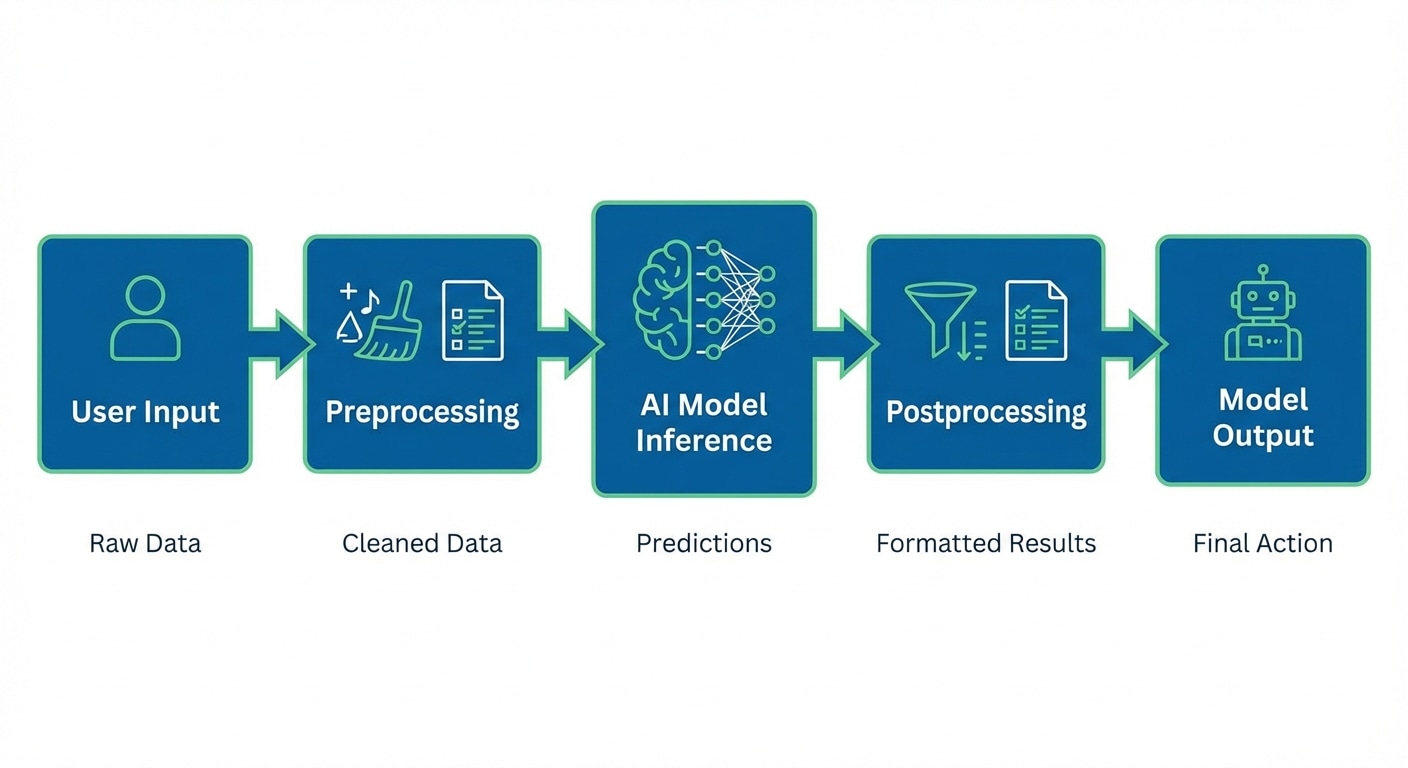
Inference is when a trained model makes predictions on new data. While training happens once, inference runs millions of times in production. Understanding the inference pipeline is crucial for deploying AI systems that are fast, efficient, and reliable.

The pipeline involves preprocessing inputs (tokenizing text, resizing images, normalising values), running the forward pass through model layers, and postprocessing outputs (decoding tokens, formatting responses, applying thresholds). Each stage offers optimisation opportunities.

Common optimisations include quantization (reducing precision from FP32 to INT8), pruning (removing unimportant weights), distillation (training smaller models to mimic larger ones), and batching (processing multiple inputs together for GPU efficiency).

Latency considerations matter for user experience. First token latency determines perceived responsiveness. Tokens per second affects total generation time. For production systems, balance quality against speed based on your specific use case and user expectations.
Fine-Tuning AI Models Explained

Fine-tuning

Fine-Tuning: Adapting Pre-trained Models

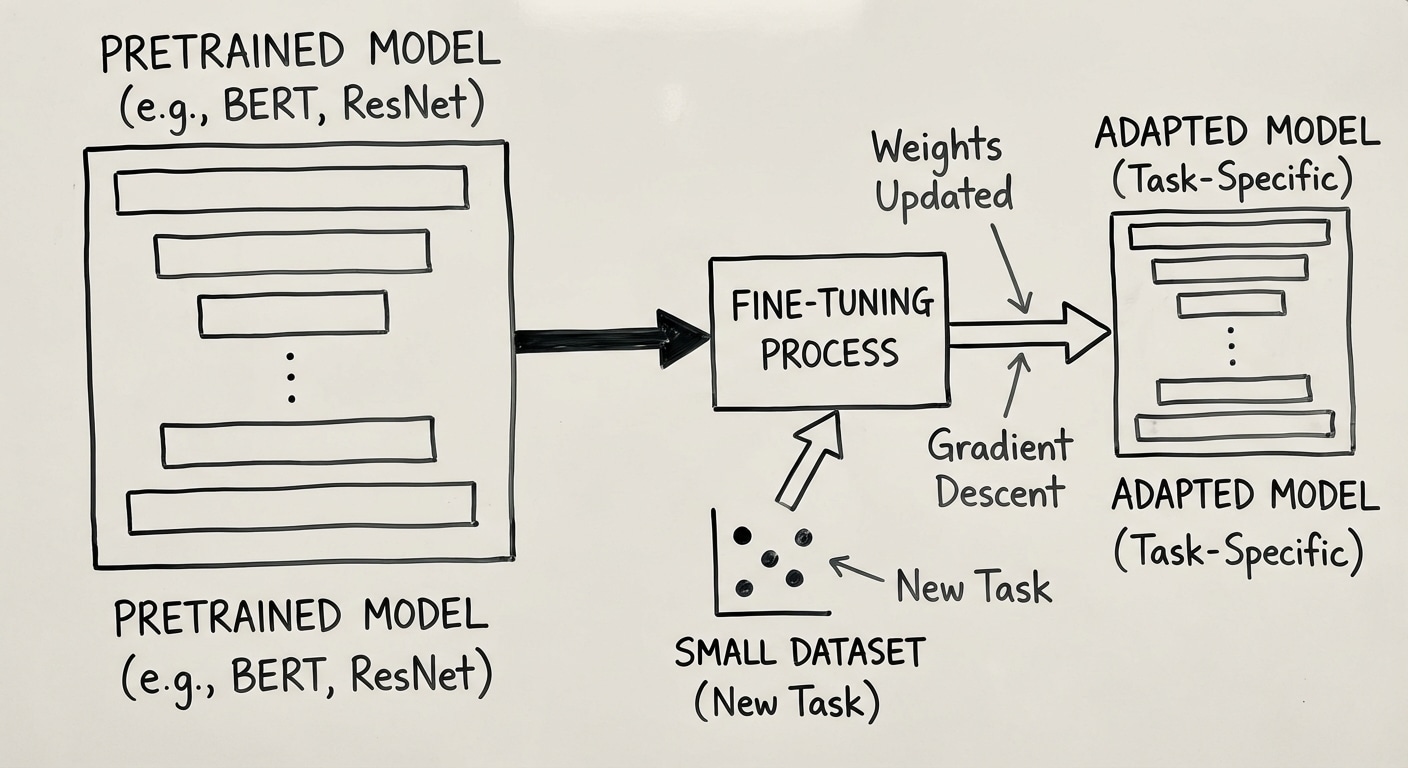
Fine-tuning transfers knowledge from large pre-trained models to specific tasks with limited data. This paradigm revolutionized AI by making powerful models accessible without requiring massive datasets or compute budgets for each new application.

The process involves taking a model pre-trained on massive general data, then continuing training on task-specific data with a lower learning rate. The pre-trained weights provide excellent initialisation, and fine-tuning adapts them to the new domain.

Different strategies trade off between performance and efficiency. Full fine-tuning updates all parameters for best results but requires significant compute. LoRA adds small trainable matrices alongside frozen weights, achieving 90%+ of full fine-tuning performance with a fraction of parameters.

Best practices include using lower learning rates than pre-training, employing warmup steps, monitoring validation loss for early stopping, and considering gradual unfreezing where deeper layers train first before unfreezing earlier layers.

GPT Architecture Explained

GPT

GPT: Inside Large Language Models

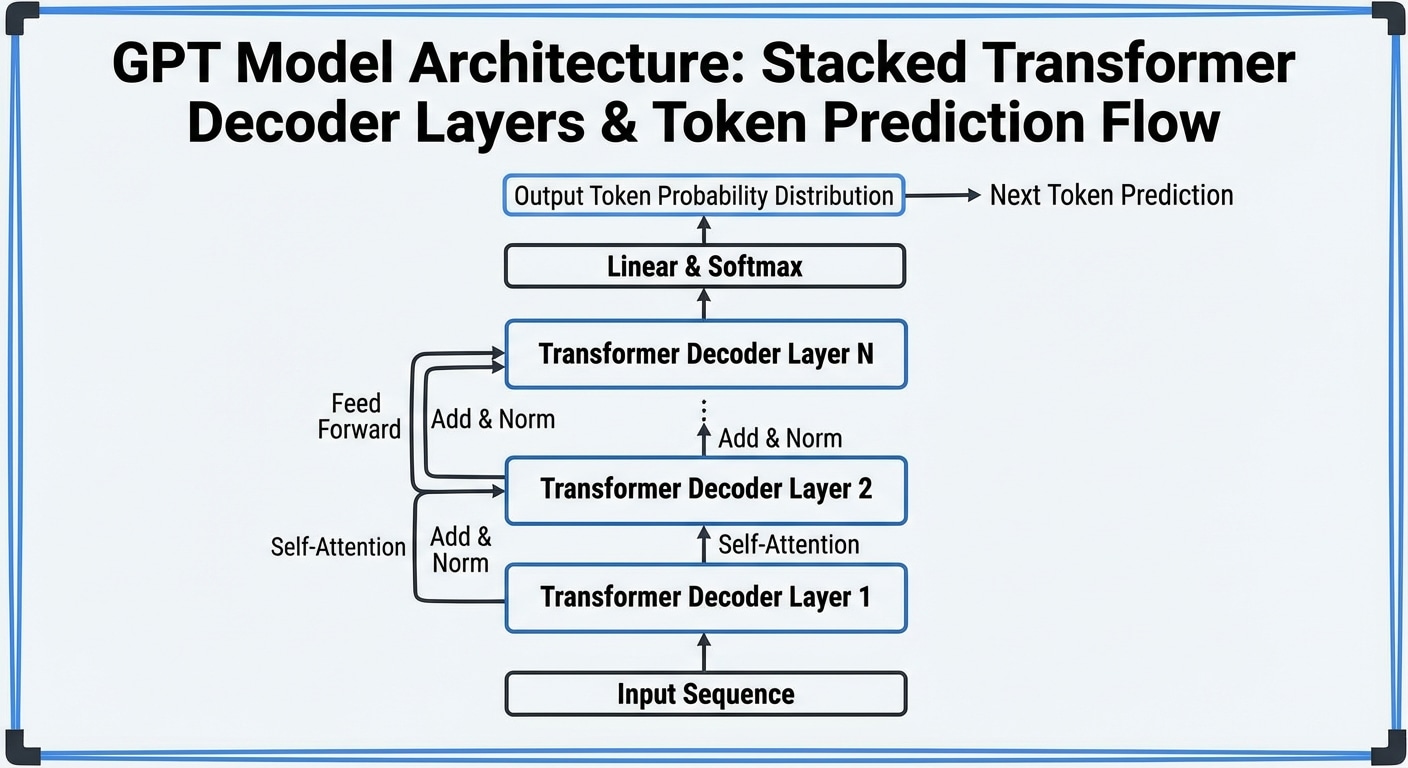
GPT (Generative Pre-trained Transformer) uses a decoder-only architecture to generate text token by token. Understanding its internals reveals how modern AI achieves remarkable language capabilities through elegant architectural choices.

Each token receives embedding plus positional encoding, then passes through stacked Transformer blocks. Each block contains masked self-attention (can only attend to previous tokens) and feed-forward networks. This autoregressive structure enables coherent text generation.

Scale proves critical for emergent capabilities. GPT-2 had 1.5B parameters, GPT-3 scaled to 175B, and GPT-4 reportedly exceeds a trillion. With scale comes surprising abilities: few-shot learning, reasoning, and code generation that emerge without explicit training.

Generation works by processing input tokens through all layers, predicting probability distribution over vocabulary for the next token, sampling from that distribution, appending the result, and repeating. Temperature and top-p sampling control creativity versus coherence.